RSS

Blog

The Best Nozzle for Pressure Washing Concrete
(0) The Best Nozzle for Pressure Washing Concrete

When it comes to power washing concrete, not all nozzles are created equal. Concrete surfaces—whether driveways, sidewalks, or warehouse floors—require high-impact cleaning to lift deep-set grime, oil, algae, or efflorescence. But using the wrong nozzle can lead to uneven cleaning, wasted time, or even surface damage. So, what nozzle should you use for power washing concrete?

If you’re tackling concrete—whether it’s driveways, sidewalks, or patios—the best choice is a rotating (turbo) nozzle. These nozzles deliver the powerful, concentrated impact of a 0° tip but with the efficiency of a spinning, fan-like spray pattern. There are some factors to consider when selecting a nozzle for concrete, such as the size of the tip, as well as the specific type of concrete surface you need to clean. 

In this guide, we will walk through the different types of nozzles and when to use them. (For information on all high-pressure nozzle types, read this guide.)


The Best Pressure Washer Nozzle Options for Concrete

As we mentioned, for most concrete surfaces, the best nozzle you can use is a rotating (turbo) nozzle—and here’s why. Unlike standard spray tips that produce a fixed spray pattern, turbo nozzles harness the cutting power of a 0° solid stream tip and add a spinning action that rapidly rotates the jet in a circular pattern. This creates a high-impact, cone-shaped blast that delivers deep cleaning power over a wider area—making them especially effective for lifting grime, oil, algae, and embedded debris from rough concrete textures.

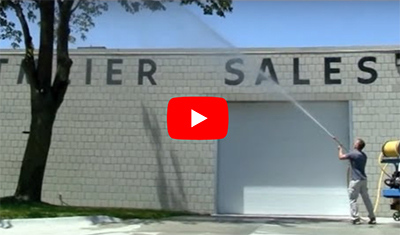
Rotating Turbo Nozzle Demo Video: 

The rotating action doesn’t just clean more thoroughly—it also helps prevent damage. Because the 0° stream is constantly moving, it doesn’t stay fixed in one spot long enough to etch or gouge the surface. This makes turbo nozzles ideal for cleaning driveways, sidewalks, loading docks, and even concrete walls, offering a balance of intensity and coverage that other nozzle types simply can’t match. They're also highly efficient—cutting cleaning times significantly compared to flat or fan-style tips.

How Does a Turbo Nozzle Work?

When water enters a turbo nozzle, it’s under very high pressure—usually anywhere from 2,000 to 5,000 PSI. This powerful stream is forced through a very small hole (called an orifice), which focuses it into a tight, needle-like jet. At this stage, the water jet is incredibly strong, just like what you’d get from a standard 0° red-tip nozzle. However, that intense stream alone would only clean in a tiny spot. That’s where the magic of a turbo nozzle begins.

Inside the nozzle, that narrow water jet hits a spinning piece—called a rotor or impeller—at an angle. As the jet strikes it, the rotor begins to spin rapidly, thousands of times per minute. This makes the straight water stream rotate in a circular pattern, like it’s sweeping across the surface in tiny, fast circles. The result? You get the cleaning power of a pinpoint jet, but it covers a much wider area like a fan spray. It’s an efficient and aggressive cleaning action that’s ideal for blasting tough grime off concrete without leaving streaks or gouges


Types of Nozzles for Concrete Power Washing

While turbo nozzles are often the top choice for cleaning concrete, they’re not the only option. Other nozzle types offer unique spray patterns and flow characteristics that can be better suited for specific tasks or surface conditions. Let’s take a closer look at the main nozzle types used for concrete cleaning and what sets each one apart.

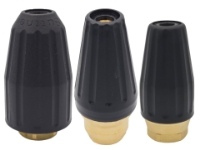
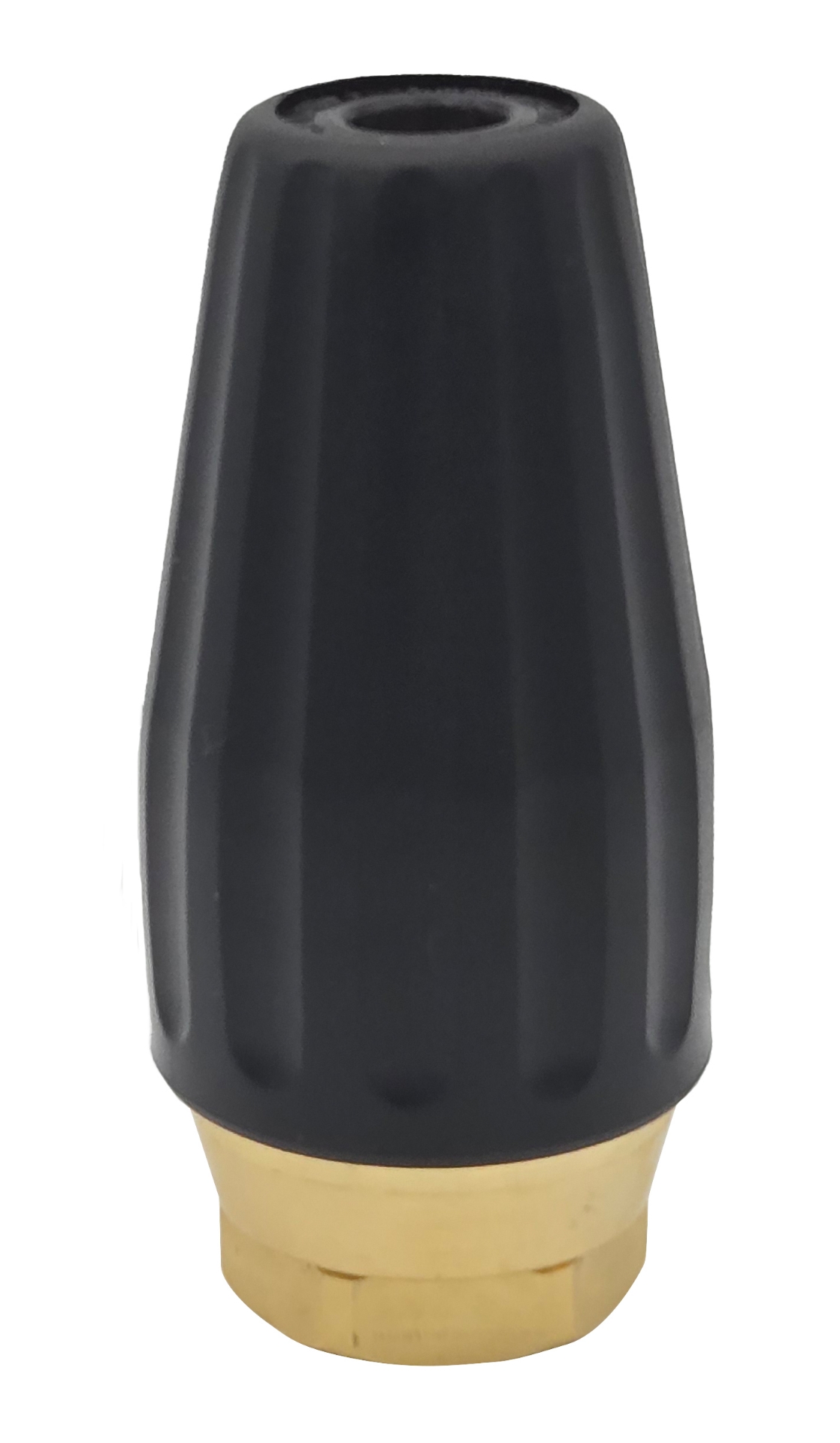
1. Rotating / Turbo Nozzles

Spray Pattern: Produces a zero-degree high-pressure stream that rotates into a rotating cone spray, dramatically improving cleaning efficiency.

When to Use: Ideal for heavy-duty concrete cleaning like driveways, parking lots, sidewalks, loading docks, and patio pavers. Especially effective for removing gum, oil stains, moss, and grime.

Examples:


2. Quick-Connect Spray Nozzles

Spray Pattern: Flexible and easy to swap, these nozzles offer different spray angles and orifice sizes depending on the job. While not as aggressive as turbo tips, the quick-coupler design is handy for swapping tips. Fits standard pressure washer female quick-couplers.

When to Use: Great for medium-duty cleaning of stamped concrete, decorative surfaces, or areas near landscaping where a turbo nozzle may be too aggressive. Also useful for rinsing and general-purpose cleaning. 

Examples: 


3. WashJet Spray Nozzles (MEG, WEG, IMEG, HVSS)

Spray Pattern: Designed for high-volume, consistent spray performance. They come in a variety of spray angle options and produce a flat fan. 

When to Use: These nozzles are ideal for surface cleaners or walk-behind units, offering even coverage across broader areas—excellent for commercial or large-scale concrete floor cleaning.

Examples: 


Key Factors to Consider When Choosing a Nozzle for Concrete

Choosing the right nozzle for cleaning concrete isn’t just about brute force — it’s about matching spray angle, orifice size, flow rate (GPM), and pressure (PSI) to the surface you’re cleaning and the results you want.

Use tools like the Pressure Washer Nozzle Color Chart to understand how number, color, and tip angle relate to cleaning power and surface impact. Then combine that knowledge with the Pressure Washer Nozzle Size Calculator to find the orifice size that matches your washer’s flow (GPM) and pressure (PSI).

Here are the key factors to consider:

FactorWhy It Matters
Pressure (PSI) & Flow Rate (GPM)Concrete removal requires enough power. Too little, and stains stay; too much, and you risk damage. Use the size calculator to get a recommended orifice size.
Orifice SizeThe orifice controls how much water flows. The wrong size causes inefficiency, damage, or ineffective cleaning. Read what happens if a nozzle is the wrong size.
Spray Pattern / AngleA narrow pattern (0° or turbo) gives cutting power; wider angles (15°, 25°, 40°) cover more surface gently. Use charts (angle, color) to see what matches your job.
Surface Type & ConditionSmooth concrete vs. stamped, new concrete vs. old or sealed surfaces — each has a different tolerance. Rough or decorative concrete may require gentler angles or lower PSI.
Durability / MaterialNozzle materials like ceramic or hardened steel resist wear. If you do high-PSI work often, get a robust turbo or rotary nozzle that can take abuse.


Do Different Types of Concrete Surfaces Impact Nozzle Choice?

Yes—surface texture and condition can influence your selection:

  • Smooth concrete (driveways, patios): A turbo nozzle works well—powerful enough to clean efficiently, but less likely to etch or damage.

  • Rough or porous surfaces (brick, stamped concrete): You may need a higher flow or solid stream nozzle to penetrate grooves.

  • Aged or sealed surfaces: Lowering pressure will help avoid lifting sealers or peeling surface layers.

In most cases, the rotative power of a turbo nozzle—and its ability to deliver high impact with wide sweep—makes it a versatile and safe choice when used responsibly.

Final Takeaway

For power washing concrete, start with a rotating (turbo) nozzle for maximum effectiveness. Match it to your washer’s PSI/GPM, use appropriate motion technique, and switch to quick-connect tips if you need to shift to gentler cleaning for nearby surfaces. Ready to make your concrete gleam? Explore our Turbo Nozzle selection online or call one of our experts to find the best one for your job.

What Happens If a Pressure Washer Nozzle Is the Wrong Size?
(0) What Happens If a Pressure Washer Nozzle Is the Wrong Size?

The nozzle on a pressure washer may look like a small part, but it plays a huge role in determining how your machine performs. The nozzle’s orifice size directly controls the balance between water flow (GPM) and pressure (PSI). If the nozzle is sized incorrectly—either too small or too large—you can run into serious issues with performance, efficiency, and even equipment life.

What Is a Nozzle’s Orifice Size?

The orifice size of a pressure washer nozzle refers to the diameter of the opening in the tip that the water is forced through. This size is expressed as a number (for example, 2.5, 3.0, 4.0, etc.), and it determines how much water can pass through the nozzle in a given time (typically measured in gallons per minute or GPM) at a certain pressure (PSI).

So What if the Nozzle is Not Sized Correctly?

Too Small a Nozzle

When a nozzle’s opening is smaller than recommended for your pump:

  • Excessive Pressure: The pump is forced to push water through a restricted opening, driving up system pressure.

  • Bypassing & Stress: Extra flow is diverted back through the unloader valve, causing it to cycle constantly. Over time, this leads to premature wear on the unloader and other pump components.

  • Excessive Power Consumption: Running at higher-than-designed pressures can draw too much power from an electric motor, causing a breaker to trip or a fuse to blow. 

In short, a nozzle that’s too small creates unnecessary strain and can shorten the life of your washer.

Too Large a Nozzle

When the nozzle opening is larger than it should be:

  • Pressure Drop: Water flows too easily through the nozzle, and your PSI falls below the level needed for effective cleaning.

  • Poor Cleaning Performance: Surfaces that need pressure to cut through grime, mold, or paint won’t clean properly, no matter how long you spray.

  • Wasted Time & Fuel: A machine running with too large a nozzle consumes resources but delivers weak results.

While this setup doesn’t typically damage equipment, it makes your washer far less effective.

Why Proper Sizing Matters

The wrong nozzle size can lead to issues with your machine. If you have a consistent issue with your power washer, check the nozzle and make sure it isn't the root cause. Choosing the right nozzle size is about finding the balance between flow and pressure that matches your pump’s specifications. When matched correctly:

  • Maximum Cleaning Power: The system delivers the PSI you need without wasting flow.

  • Efficiency: Less time and fuel wasted on jobs.

  • Longer Equipment Life: Pumps, unloaders, and seals aren’t put under unnecessary stress.

If you want help sizing your nozzle, take a look at our pressure washer nozzle charts. These tools will help find the right type of tip and the correct size to use. You can also use our pressure washer nozzle size calculator to find the right tip orifice in seconds. 

Maintenance Tip

Even a properly sized nozzle will wear over time. As the orifice enlarges, you’ll notice a gradual drop in pressure and changes in spray pattern. Replace nozzles once you see a 10–15% drop in pressure to keep performance consistent.

Key Takeaway:

  • Too small = stress and damage, too much power consumption

  • Too big = weak cleaning and wasted effort.

  • Right size = efficiency, power, and longevity.


Dultmeier Sales is here to help you find the correct power wash or pressure wash spray tip so you can avoid problems and maximize your efficiency. 


Pressure Washer Nozzle Size Calculator
(0) Pressure Washer Nozzle Size Calculator

Use our high-pressure nozzle calculator to discover the optimal tip size to use with your pressure washer:


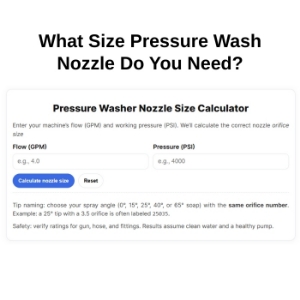
Pressure Washer Nozzle Size Calculator

Enter your machine’s flow (GPM) and working pressure (PSI). We’ll calculate the correct nozzle orifice size

Tip naming: choose your spray angle (0°, 15°, 25°, 40°, or 65° soap) with the same orifice number. Example: a 25° tip with a 3.5 orifice is often labeled 25035.

Safety: verify ratings for gun, hose, and fittings. Results assume clean water and a healthy pump.


Pressure Washer Nozzle Size Calculator: Get the Right Tip in Seconds

Use the free pressure washer nozzle size calculator above to find the correct orifice size for your machine. Enter your GPM and PSI, press Calculate, and you’ll get the optimal nozzle size.

How the calculator works

Behind the scenes, the calculator applies the standard sizing formula used across the industry: Nozzle Size = GPM × √(4000 ÷ PSI). Example: 4.0 GPM at 3000 PSI ≈ 4.62 → stock a 4.5 orifice. Another: 5.5 GPM at 2500 PSI ≈ 6.96 → stock a 7.0 orifice.

This returns the orifice number. Your spray angle (0°, 15°, 25°, 40°, 65°) is selected separately, but it uses the same orifice size. For a quick refresher on patterns, colors, and tip codes, see our pressure washer nozzle chart — what the colors and numbers really mean.

When to choose different pressure washer nozzle sizes

  • You want full rated pressure: Use the calculator’s result (closest stocked size) to match your target PSI.
  • More flow / gentler cleaning: Go one size up in orifice (pressure drops).
  • More bite on tough grime: Go one size down (pressure increases), but confirm your gun, hose, and pump are rated for the load.

If you’re still learning how different tips behave, our deep dive explains spray patterns, impact, and applications: Ultimate Guide to High-Pressure Cleaning Nozzles.

What size pressure washer nozzle do I need?

The most reliable method is to use the calculator with the GPM and PSI on your pressure washer’s spec plate. Choose the closest stocked orifice to the exact result. That size number then applies across all tip styles—quick-connect fans, turbo/rotary nozzles, and threaded WashJet-style tips—so you can pick the spray pattern for the job while keeping the correct orifice.

What happens if the nozzle is the wrong size?

An undersized nozzle spikes pressure (risking pump wear, relief valve chatter, and shorter component life). An oversized nozzle drops pressure (poor cleaning, wasted time, extra passes). Get the full rundown here: What happens if a pressure washer nozzle is the wrong size?

Shop by tip style (matched to your calculated size)

Tips for accurate results

  • Verify your machine’s actual GPM and PSI (pump label or manual).
  • Confirm component ratings (gun, hose, lance, fittings) before sizing down.
  • Replace worn tips—erosion enlarges the orifice and quietly drops your working pressure.

FAQs

How do I read pressure washer nozzle sizes?

The size is the orifice number (e.g., 4.5). Tip codes combine angle+size (e.g., 25045 = 25° fan with a 4.5 orifice). See the nozzle chart for colors, angles, and codes.

Does spray angle change the nozzle size?

No. Angle controls pattern width, but the orifice number stays the same across 0°, 15°, 25°, 40°, and 65° tips.

Will a turbo nozzle use the same size?

Yes—the internal orifice must match your calculated size. Select the orifice first, then the turbo model and flow rating.


Pressure Washer Nozzle Chart: What the Colors and Numbers Really Mean
(0) Pressure Washer Nozzle Chart: What the Colors and Numbers Really Mean

Looking for the right pressure washer nozzle? A pressure washer nozzle chart can simplify the process. With so many options—each with different spray angles, orifice sizes, and PSI/GPM ratings—choosing the right nozzle can be tricky. That’s why we’ve put together clear, easy-to-use pressure washer nozzle charts to help you match the perfect nozzle to your machine and job.

Whether you’re removing heavy grime from concrete or gently rinsing off your car, the right nozzle makes all the difference between a professional finish and potential damage.

Pressure Washer Nozzle Color Chart

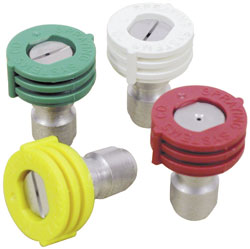
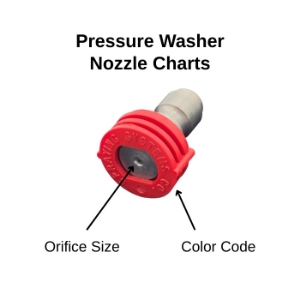
Pressure washer nozzles are universally color‑coded to make identifying spray angles simple. Each color corresponds to a specific fan angle, and that angle directly affects cleaning power and surface safety. (The color does not indicate nozzle size, more on that later.)

In the chart below, you can see the different colors of pressure washer nozzles, their specs, and uses.

ColorSpray AngleOrifice SizeCommon Use Cases
🔴 Red2.0–6.5+Cutting power; use on metal, concrete only
🟡 Yellow15°2.0–6.5+Removing paint, mildew from hard surfaces
🟢 Green25°2.0–6.5+General cleaning: vehicles, surfaces, decks, patios, fences
⚪ White40°2.0–6.5+Vehicles, windows, soft wood, siding
⚫ Black65°2.0–6.5+Low-pressure soap application

For a more detailed look at high-pressure nozzles, read this full guide


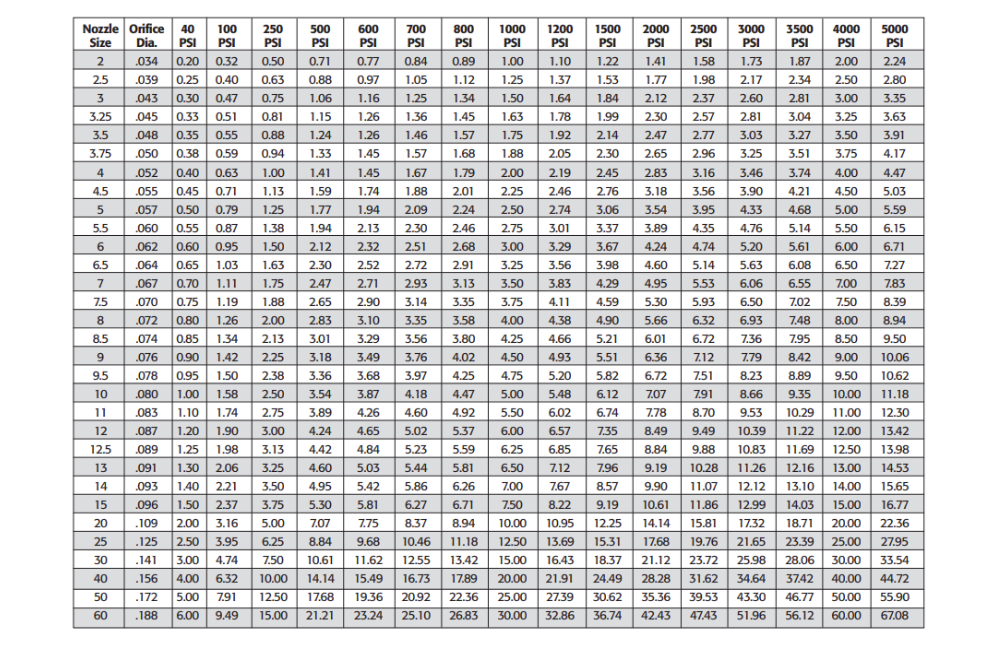
Pressure Washer Nozzle Size Chart

This nozzle chart helps you select the correct nozzle orifice size for your pressure washer based on your machine’s PSI (pressure) and GPM (flow rate) ratings. Getting this right ensures your washer delivers peak performance without damaging the pump or surface you're cleaning.

Step-by-Step Instructions to Use This Pressure Washer Nozzle Size Chart

1. Find Your Pressure Washer’s Rated PSI

Look at the top row of the chart. This is your pressure washer’s PSI rating. Common values are 2000, 2500, 3000, 4000 PSI, etc.

2. Find Your Desired GPM or Flow Performance

Look down the columns under your PSI until you find the closest GPM value to your machine’s rating.

If your machine is rated at 3.5 GPM @ 3000 PSI, scroll down the 3000 PSI column until you find the value closest to 3.5.

3. Move Left to Find the Correct Nozzle Size

Once you locate your approximate GPM under the correct PSI column, move left across the row to find the corresponding nozzle size.

Example:

Let’s say you’re using a pressure washer rated for 1500 PSI and 4.0 GPM.

  1. Go to the 1500 PSI column.

  2. Scroll down until you find a value close to 4.0 GPM — follow the row all the way to the Nozzle Size column. In this example, we find the 6.5 nozzle size.

  3. That means you should use a 6.5 orifice nozzle.


While it is important to understand the formula behind this, you can skip the math and use our calculator to find the right nozzle size


Tips on Choosing the Pressure Washer Nozzle

  • Match spray angle to surface - Always start with a gentle, wider nozzle (e.g., 40°) and only go narrower if needed. 

  • Select the proper size - matching the nozzle orifice to your machine is imperative to avoid issues and maximize cleaning efficiency. For more information, refer to this guide on the importance of selecting the proper pressure washer nozzle size. 

  • Consult your pressure washer experts - Dultmeier Sales has power wash experts available to offer guidance and walk you through nozzle sizing if you need help.  


High-Pressure Nozzle Options 

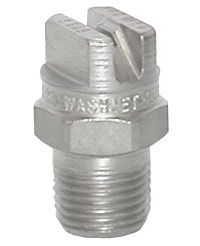
Armed with these nozzle charts, you can browse the variety of color-coded quick-connect pressure washer nozzles and threaded stainless steel nozzle sizes to find the one you need:

Transfer Pump Selection Guide
(0) Transfer Pump Selection Guide

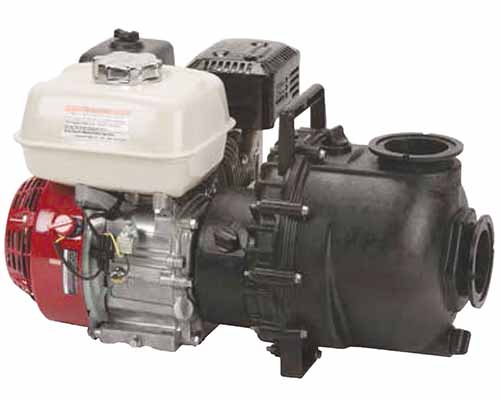
The term 'transfer pump' is commonly used to describe any type of pump that moves fluids from one location to another. Centrifugal pumps are often used as transfer pumps for large volumes, but different pump types can be used. It all depends on the application.

There are so many pump types used across various industries that selecting the proper pump for your task may seem overwhelming, but we can help narrow it down! We have decades of combined experience finding pumps to fit specific applications. From high-volume water transfer to pumps to small pumps that deliver fluid in low doses, and everything in between. 

Let's run down the types of transfer pumps, then walk through how to select the proper pump for your needs. 


What is a Transfer Pump? 

All pumps move fluid, but typically, we think of a transfer pump as a low-pressure means of moving fluid from point A to point B in an efficient manner. This differs from pumps intended for specific applications, such as piston or plunger pumps, which are designed to generate high pressure to facilitate some task or process, such as cleaning or dosing.

Transfer pumps need to be compatible with whatever fluids you need to move, and they should be sized for maximum efficiency based on the requirements of the task and budget.

Different Types of Transfer Pumps

Here are the basic pump types used for transferring fluids:

Centrifugal Pumps

Most people probably think of a centrifugal pump when using the term transfer pump. They are made for moving high volumes. Centrifugal pumps stand apart from other pump types because they work on different principles. Centrifugal pumps move low-viscosity fluids using a spinning impeller, producing a smooth flow that changes with pressure.

The majority of other pumps fall into the positive displacement pump category (roller pumps, gear pumps, diaphragm pumps, etc). These pumps move fluid by trapping and pushing fixed amounts, making them ideal for thicker liquids and steady flow needs.

Why does this matter? A centrifugal pump performs differently from positive displacement types. A centrifugal pump is only as effective as its plumbing. More detailed explanations of the types of pumps and how to maximize flow rate with plumbing can be found in this guide.

  • Common Uses: Water, wastewater, light oils, diesel, brine, fertilizer, chemicals

  • How They Work: Use an impeller to create centrifugal force that moves fluid by adding "head"

  • Examples: Self-priming pumps, multistage pumps, submersible pumps, trash pumps

Bottom line: Use a centrifugal pump to move large volumes of water or other low-viscosity fluids. If you're not sure what pump you need and flow is more important than pressure, start with these pumps.


Positive Displacement Pumps

While centrifugal pumps rely on velocity and kinetic energy to move fluid—and are ideal for high-flow, low-pressure applications—they aren’t always the best choice when consistent flow is required under varying pressure. That’s where positive displacement pumps come in. Unlike centrifugal models, these pumps move a fixed volume of fluid per cycle, delivering a steady, predictable flow regardless of changes in system pressure (within design limits).

Gear Pumps

When a fluid is too thick or viscous for a centrifugal pump to work efficiently, a gear pump is often a great option. Gear pumps consist of a housing enclosed around two gears, driven by a single drive shaft. They are simple, compact pumps that can be installed easily.

Unlike centrifugal pumps, they will push liquid through restrictions and maintain flow up to a certain pressure limit. Gear pumps can also be equipped with internal relief valves to protect the pump & plumbing from damage if the pump becomes deadheaded or significantly restricted.

They work especially well with high-viscosity, non-abrasive fluids and are commonly used in systems requiring consistent volume and pressure.

  • Common Uses: Heavy oils, liquid feeds, hydraulic fluids, chemical transfer

  • How They Work: Rotating gears trap and move fluid through the pump chamber

  • Examples: Cast iron gear pumps, stainless steel chemical gear pumps, hydraulic-drive gear pumps

Bottom line: Choose a gear pump for clean, viscous fluids where steady flow and moderate pressure are needed. They’re durable, compact, and easy to maintain.


Diaphragm Pumps

Diaphragm pumps are often the preferred choice for viscous fluids over gear or centrifugal pumps due to their unique pumping mechanism and fluid-handling capabilities.

Unlike centrifugal pumps, which lose efficiency as viscosity increases, diaphragm pumps use a flexing diaphragm to physically push fluid, making them ideal for thick, sticky substances that don’t flow easily. Performance remains strong even with very high viscosities.

Compared to gear pumps, many diaphragm pumps (specifically AODDs or air-operated double diaphragm pumps) offer better solids-handling and are more tolerant of abrasive or shear-sensitive fluids. They can run dry without damage, are typically self-priming, and provide gentle, pulsed flow that won’t damage the product—especially important for slurries, food products, coatings, or chemicals.

  • Common Uses: Corrosive chemicals, wastewater, fuel, food products, thick slurries

  • How They Work: A flexible diaphragm moves back and forth to create suction and discharge

  • Examples: High-pressure diaphragm pumps, air-operated double diaphragm pumps (AODDs), chemical dosing pumps

Bottom line: Diaphragm pumps are best for thick, abrasive, or sensitive fluids—especially when chemical resistance, dry-run capability, or portability is important.


Vane Pumps


There are different types of vane pumps, but they are known for their ability to handle vapors. They are often the best choice for handling fuels compared to centrifugal and other pump types. They also provide precise, consistent flow regardless of pressure, a key advantage over centrifugal pumps, whose flow drops significantly as system pressure increases.

Compared to other positive displacement pumps like gear or piston types, vane pumps are smoother and more forgiving with thin, volatile fluids. They handle small amounts of vapor or air without stalling, and their sliding vanes maintain tight internal sealing, ensuring efficiency with even the lightest fuels.

  • Common Uses: Gasoline, diesel, jet fuel, kerosene, light oil

  • How They Work: A rotor with sliding vanes spins inside an eccentric chamber, trapping and moving fluid toward the discharge

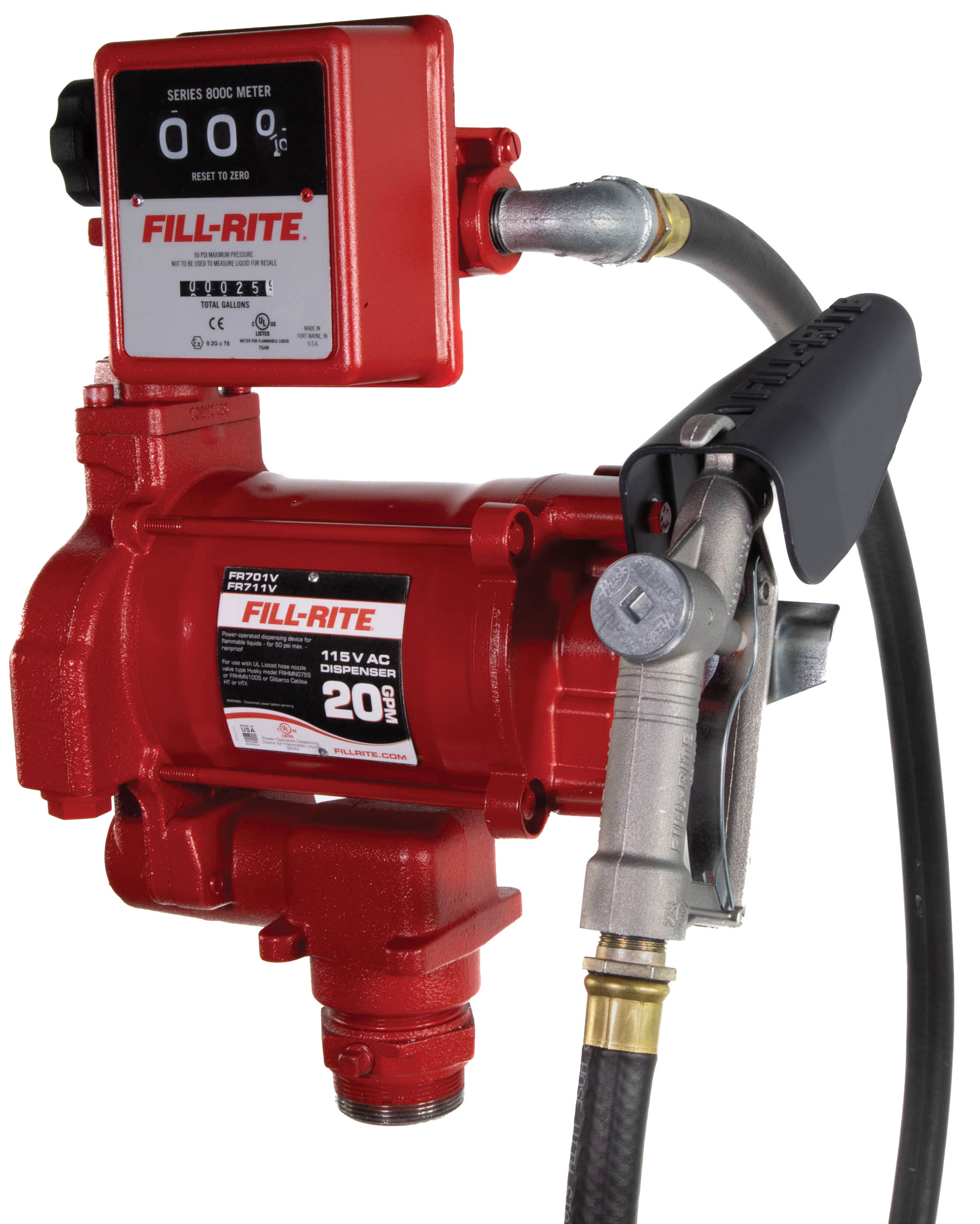
  • Examples: Rotary vane fuel pumps, mobile fuel transfer pumps such as Fill-Rite FR700 or 1200 series

Bottom line: Use vane pumps when transferring fuel or other thin liquids that require consistent delivery and strong suction, especially in mobile or metered systems.


Key Factors to Consider When Choosing a Transfer Pump

Each of these pump types is suited to specific applications and fluid types, with various sizes and configurations available within each type. The selection of the right transfer pump depends on factors such as fluid viscosity, chemical compatibility, pressure, flow rate requirements, and environmental conditions.

We can begin to zero in on the right pump type or family of pumps by considering several questions:

What are you transferring?

  • Is the fluid clean or does it contain solids (e.g., sand, sludge, slurry)?

  • Is the fluid thick or viscous (e.g., thick oils, molasses) or thin (e.g., water, gasoline)?

  • Is the fluid corrosive or chemically reactive (e.g., acids, solvents, fertilizers)?

  • Is the fluid flammable or hazardous (e.g., gasoline, diesel)?

With any liquid, it is important to consider the best pump materials. There is no "one-size-fits-all" material, and sometimes the best option for even a corrosive or acidic substance is not always the most expensive. We reference chemical compatibility charts put together from industry research to identify what works.  

With several different types of fluids, such as diesel, DEF, and fertilizer, we can make recommendations and identify pumps based on experience and direct feedback from users. Once we know the liquid, we can discuss the flow requirements and your system's plumbing.

How much flow do you need?

This is important, but it can be hard to gauge. You may not know the exact gallons per minute flow, but we can look at the amount of time you want your task accomplished. If the goal is to fill semi-tankers that range from 3000-5000 gallons in capacity and you want to do it in 8  minutes or less, you will need a pump that can move over 600 GPM through your plumbing.

If you need to fill five-gallon buckets from a tote or storage tank, you need to consider how long you want to stand there filling. A 10 GPM pump might do it in 30 seconds, but it could be way more costly than a 5 GPM pump. Maybe filling twice as fast will justify the cost, and maybe not; this, of course, depends on your situation. 

How far and how high are you pumping?

Flow rate may be the key, but there is more to it than just the pump; it’s important to consider your hose/pipe diameter, plumbing layout, and other items like strainers, flow meters that add backpressure. They all affect actual performance, especially for centrifugal pumps. A pump may be capable of high flow, but undersized hoses, restrictive fittings, and sharp bends can really limit flow rate for centrifugal pumps and build excessive system pressure for positive displacement pumps.

Elevation changes and long discharge lines also create backpressure, reducing efficiency. To select the right pump, factor in not just the fluid and flow rate, but the entire system—plumbing, elevation, and restrictions included. 

At Dultmeier, we use software and have staff well-versed in sizing pumps according to your existing or planned plumbing. If you can provide details, we can guide you to a pump that will work and stand behind it through the entire process to ensure proper performance, even if that means helping you identify adjustments in your layout to achieve greater efficiency.

Total Dynamic Head

The details of your plumbing will allow us to determine the total dynamic head or TDH. With this information, we can identify the flow rate a pump can produce within your system. We use the pump curves provided by the manufacturers to find this information. You can learn more about pump curves in our centrifugal pump sizing guide


Additional Transfer Pump Details to Consider

Once the liquid is known and flow requirements are determined based on the plumbing system, we can examine some more specific questions:

What type of power source is available?

  • Electric (110V, 220V, 1-phase or 3-phase?)
  • Gas engine
  • PTO
  • Hydraulic
  • Air (compressed air)

How often will this pump run? Occasional use, daily, continuous 24/7; this will help determine the proper motor or drive type.

Will the pump be mobile or stationary?

Is the pump above the fluid source, or will it be flooded/suction-fed? Not all pumps are self-priming and need to be gravity-fed. 

Do you need it to run dry? Some pumps, like AODDs or "wet seal" centrifugal pumps, can run dry safely; others can’t.


Transfer Pump Selection FAQ

What is the best pump for DEF? 

Many different pump types can handle DEF. The key is finding a pump made from compatible materials. You can see the exact pumps suited for DEF in this guide.  

What is the highest flow transfer pump? 

Centrifugal pumps are designed for high-volume transfer; however, there are other factors to consider. Fluid type and plumbing plays a major role. Be sure to read our guide on the highest flow pump options for different fluid types. 

Can a transfer pump run dry?

Not all pumps can run dry safely. Air-operated diaphragm pumps (AODDs) and some "wet seal" centrifugal pumps are designed for dry-run tolerance. However, most centrifugal, gear, and vane pumps require fluid for lubrication and cooling—running them dry can damage internal components. Always check the pump’s dry-run capability before operating.

How far can a transfer pump push water?

The distance depends on the pump’s flow versus head curve and the plumbing system's total dynamic head (TDH). Most centrifugal pumps can push water hundreds of feet horizontally if the elevation change is minimal. For vertical lift, check the pump’s maximum head—this represents the highest net elevation gain (net vertical head) it can push fluid. 


Need Help? 

If you need help pinpointing a pump that will work for you, contact us and speak to one of our experienced staff members. 


Shane Blomendahl, Author

Tech Ag & Industrial Sales

Shane Blomendahl is a tech sales veteran at Dultmeier Sales with over 10+ years of experience in liquid handling products covering several industries and applications.

Learn More About the Author


Article reviewed by Tom Hansen, P.E.

The Complete Beginner’s Guide to Agricultural Sprayer Nozzles
(0) The Complete Beginner’s Guide to Agricultural Sprayer Nozzles

What Every Farmer, Turf Pro, and Applicator Needs to Know

Whether you're protecting a soybean field from weeds or applying fungicides on turfgrass, you need the right sprayer nozzle to achieve the results you want. These nozzles may be small, but they control critical factors: the amount of product applied, where it lands, how evenly it's distributed, and the amount of drift that occurs.

When it comes down to it, nozzles are the most important aspect of your sprayer. Choose wrong and you risk wasting product, losing time, and damaging your crop (or even your neighbor’s).

The problem? Sprayer nozzles can be confusing. Between color codes, flow rates, droplet sizes, and dozens of nozzle types, it’s easy to get overwhelmed. That’s the reason for this guide. 

Whether you're a farmer dialing in your self-propelled sprayer, a golf pro applying fertilizer to fairways, or a pest control operator looking to reduce drift, this is your complete beginner’s guide to sprayer nozzles. We’ll walk you through the different types of nozzles, sizes, color codes, and droplet ranges so you can confidently select the proper nozzle for your application.


TL;DR: The Complete Beginner’s Guide to Agricultural Sprayer Nozzles

    • Nozzles control droplet size, spray pattern, and flow rate—directly impacting coverage, drift, and application accuracy.

    • The terms “nozzle” and “tip” are often used interchangeably, but they are distinct - the tip refers to the orifice that shapes the spray.

    • Most nozzle setups include a tip, cap, and body, which attach to the boom via threads or quick-attach fittings.

    • Spray patterns (flat fan, cone, stream, etc.) determine distribution and coverage. Spray angle also impacts overlap and spacing.

    • Droplet size affects coverage and drift—fine droplets offer better contact but more drift, coarse droplets resist drift but may reduce coverage.

    • Nozzle codes and color reveal spray angle, flow rate, and help ensure proper replacement and selection.

    • Select nozzles based on your specific application, product label, sprayer type, and operating conditions.

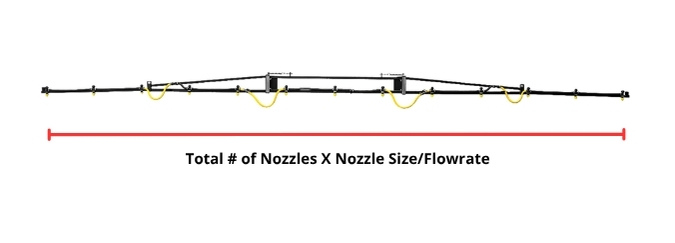
    • Use the formula GPA × MPH × Spacing ÷ 5,940 to calculate nozzle size (GPM).

    • Nozzle charts help you match the right nozzle to your pressure, speed, and application rate.

    • Calibration and maintenance are critical—worn nozzles cause misapplication. Check for wear regularly and clean properly after use.


Why Nozzles Matter in Spraying

Nozzles control droplet size, spray pattern, and flow rate — all of which directly affect coverage and application accuracy. Here’s what each factor means and why it’s important.
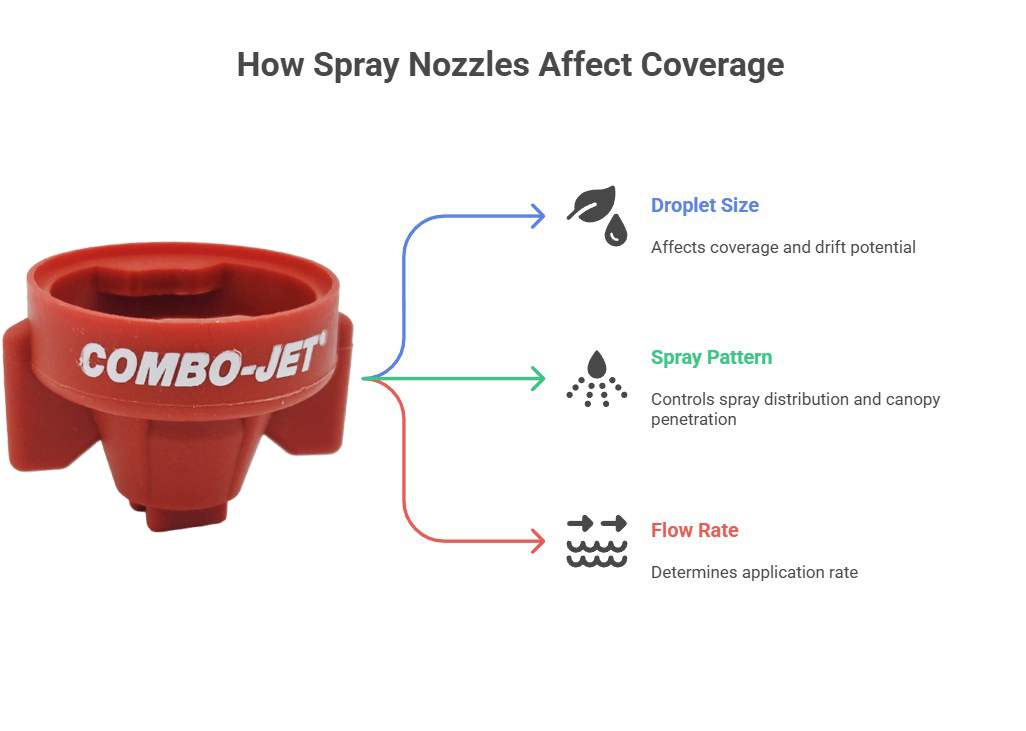
 

diagram showing the way a spray nozzle affects coverage

How Nozzles Impact Spraying Performance:

  • Droplet Size: This determines how the spray behaves in the air and its ability to hit the intended target. Smaller droplets provide better surface coverage and penetration, but are more prone to drift. Larger droplets resist drift but may offer less contact coverage.

  • Spray Pattern: Whether it’s a flat fan, cone, or stream style nozzle, the pattern controls where and how the spray is distributed — critical to ensure proper overlap between each nozzle and offer canopy penetration in dense crops.

  • Flow Rate (GPM): The nozzle's size determines how much liquid passes through it at a given pressure, which determines exactly how much product that nozzle can apply in terms of a gallon per acre rate. This is key to applying the correct application rate.

Bottom line: Your coverage is a result of droplet size, pattern, flow rate, and operating conditions. If one single factor is out of line, it can lead to missed targets, wasted product, or ineffective results — driving up costs and reducing effectiveness. Nozzles ultimately determine if your sprayer gets the job done. The sprayer pump, hose, strainer, GPS, or even your rate controller do not impact the sprayer's ability to eliminate pests and prevent crop damage as much as the nozzles.

So with this in mind, let's get you up to speed with the finer details of sprayer nozzles. 


Nozzles vs. Tips – What’s the Difference?
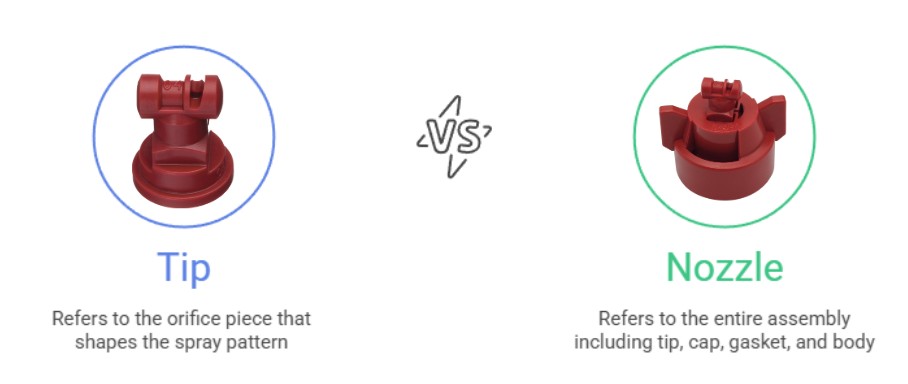
spray nozzle versus spray tip

To avoid confusion, it is necessary to define exactly what we mean when referring to sprayer nozzles. In sprayer terminology, “nozzle” and “tip” are often used interchangeably—but there’s a subtle distinction:

  • Tip typically refers to the part of the nozzle assembly that shapes and directs the spray pattern (the orifice piece).

  • Nozzle can refer to the entire assembly—which may include the tip, cap, gasket, and nozzle body.

Many users and manufacturers casually use “nozzle” to mean just the spray tip.

Anatomy of a Spray Nozzle

Spray nozzles come in a wide variety of styles, but most share a basic design: a tip (or orifice) that shapes the spray, a cap that secures the tip, and a nozzle body that connects the assembly to the boom or wand.

The cap threads or twists onto the nozzle body, holding the tip in place while allowing for easy removal and replacement. Some nozzles are one-piece designs, with the tip and cap molded together for convenience.

How Nozzles Attach to the Boom

The nozzle body mounts directly to the spray boom or wand and serves as the base for the nozzle assembly. Most bodies use either a threaded connection (like 11/16" nozzle body thread) or a quick-attach system with twist-lock tabs.

In threaded systems, the cap screws onto the nozzle body. In quick-attach systems, the cap locks in place with a quarter-turn, making swaps fast and tool-free.
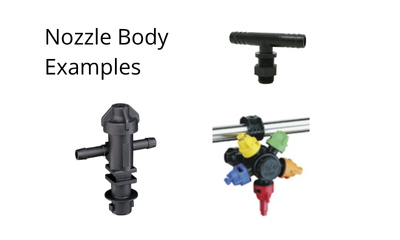
 

The type of nozzle body used depends on boom design, nozzle spacing, and your sprayer setup. There are nearly as many body styles as there are nozzles, so compatibility matters.


Overview of key nozzle components

Flat fan nozzles for boom sprayers typically include a tip, cap, and gasket.
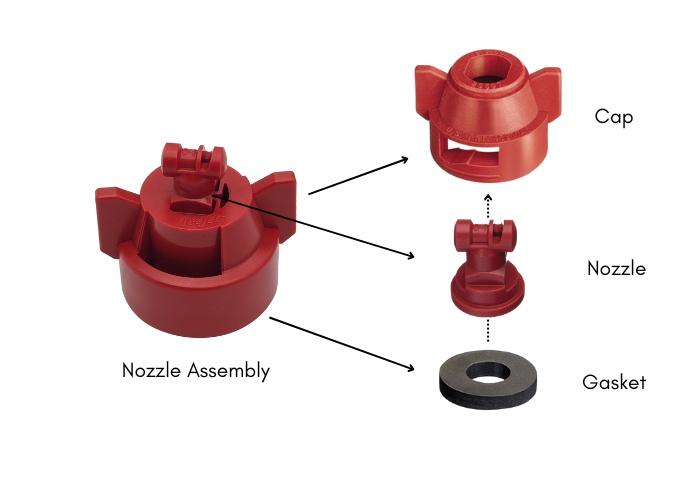
diagram showing the components that make up a sprayer nozzle

Some manufacturers offer integrated designs like Wilger’s molded one-piece nozzles, combining cap and tip.

 one piece spray nozzle with tip cap and gasket

In addition to boom sprayer nozzles, there are one-piece nozzles for use on sprayer wands:
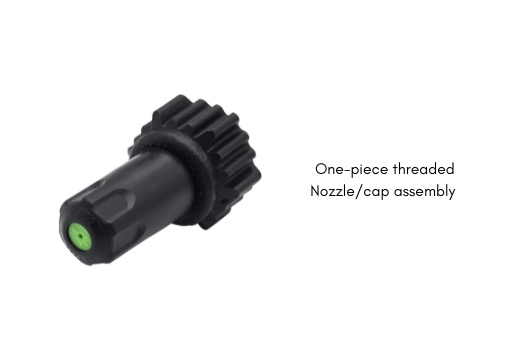
Further complicating the matter, there are any number of specialty nozzles, orifice plates, boomless nozzles, and flood nozzles that may require adapters and other accessories. We don’t have room on this page to cover all the variations, but if you need assistance adapting spray nozzles to a sprayer, reach out to our staff. They are experienced and have hundreds of nozzle adapters at their disposal.


Spray Nozzle Patterns

A sprayer nozzle pattern refers to the shape and distribution of the fluid as it exits the nozzle. There are several different types with subtle variations within each one. As you will find in the spray nozzle world, subtle differences can result in a substantially different output or application.
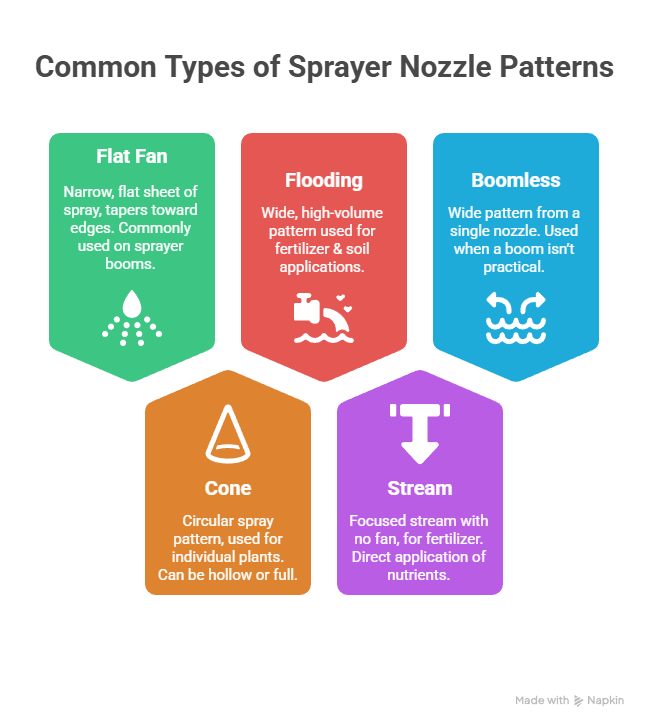
different spray nozzle patterns

Pattern affects how the nozzle needs to be spaced, the drift reduction capability, the penetration, how your application rate is determined, and more. Here are the common sprayer nozzle types:

  • Flat Fan – Narrow, flat sheet of spray that tapers toward the edges of the fan—commonly used on sprayer booms spaced at intervals to allow the fans to overlap.
  • Cone (Hollow and Full) – Circular spray—used for coverage of individual plants or targeted areas.
  • Flooding – for drift reduction; fertilizer and soil-applied applications.
  • Stream/Jet: Focused stream with no fan—used for fertilizer application
  • Boomless: Wide pattern from a single nozzle—used when a boom isn’t practical.

Spray angle is an important aspect of a spray nozzle's pattern. As I mentioned above, there are slight variations of pattern within each pattern family. For example, flat fan nozzles can have spray patterns that produce 80, 110, 120 degree fans or others. Spray angle affects the coverage at different boom heights and spacing. 

There is a lot more to each nozzle type, including how they should be spaced, the coverage they offer, etc. You can learn more in our complete guide to spray nozzles and the patterns they produce. It explains how the patterns affect coverage and how to select the correct type for your needs. 


Droplet Size

One of the most important—and often overlooked—aspects of spray application is droplet size. The size of the droplets dispersed by a spray tip is a major factor in coverage, canopy penetration, and drift. 

What Are Droplet Sizes?

Sprayer nozzles break liquid into droplets as the spray exits the tip. These droplets vary in size, typically measured in microns (µm). (For reference, a human hair is about 70 microns wide.)

Spray droplet sizes are grouped into categories based on standards set by agricultural engineering organizations. These classifications help applicators choose the right droplet size for effective coverage, drift control, and compliance with pesticide labels. By following these guidelines, users can make informed decisions about nozzle selection and spraying practices to get the best results in the field.

Droplet Size Categories
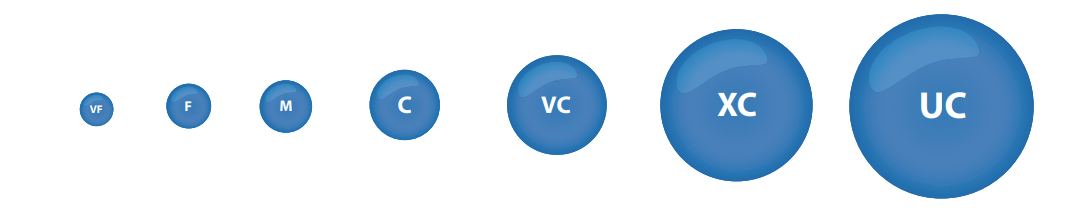
Droplets are categorized into different size categories ranging from Very Fine to Ultra Coarse. The smaller droplets will generally result in better coverage but are susceptible to drift. The larger the droplet, the less drift, but there is less surface coverage. 

Generally speaking, finer droplets are good for contact herbicides while coarser droplets are good for systemic herbicides and less effective for contact sprays. If you want to go deeper into nozzle droplet size, then be sure to read this article that provides a lot more detail. 
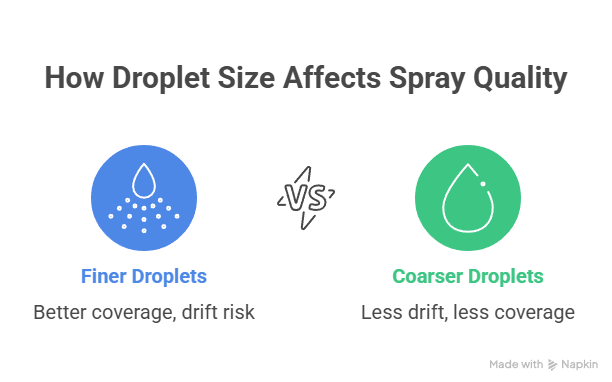
diagram showing how droplet sizes affect spray quality


Nozzle Color Codes and Sizing

They may seem insignificant, but the numbers and letters printed on them carry a lot of important information. Typically, the numbers will indicate the nozzle flow rate and spray pattern angle. For flat fan nozzles, these codes are based on an international standard (ISO 10625), and once you understand how to read them, picking the right nozzle becomes much easier.

What the Numbers Mean

The numbers on a nozzle refer to the spray angle and the capacity or flow rate. The first group of numbers tells you the angle in degrees of the fan or cone. The second group of numbers will tell you the flow rate of the nozzle. 
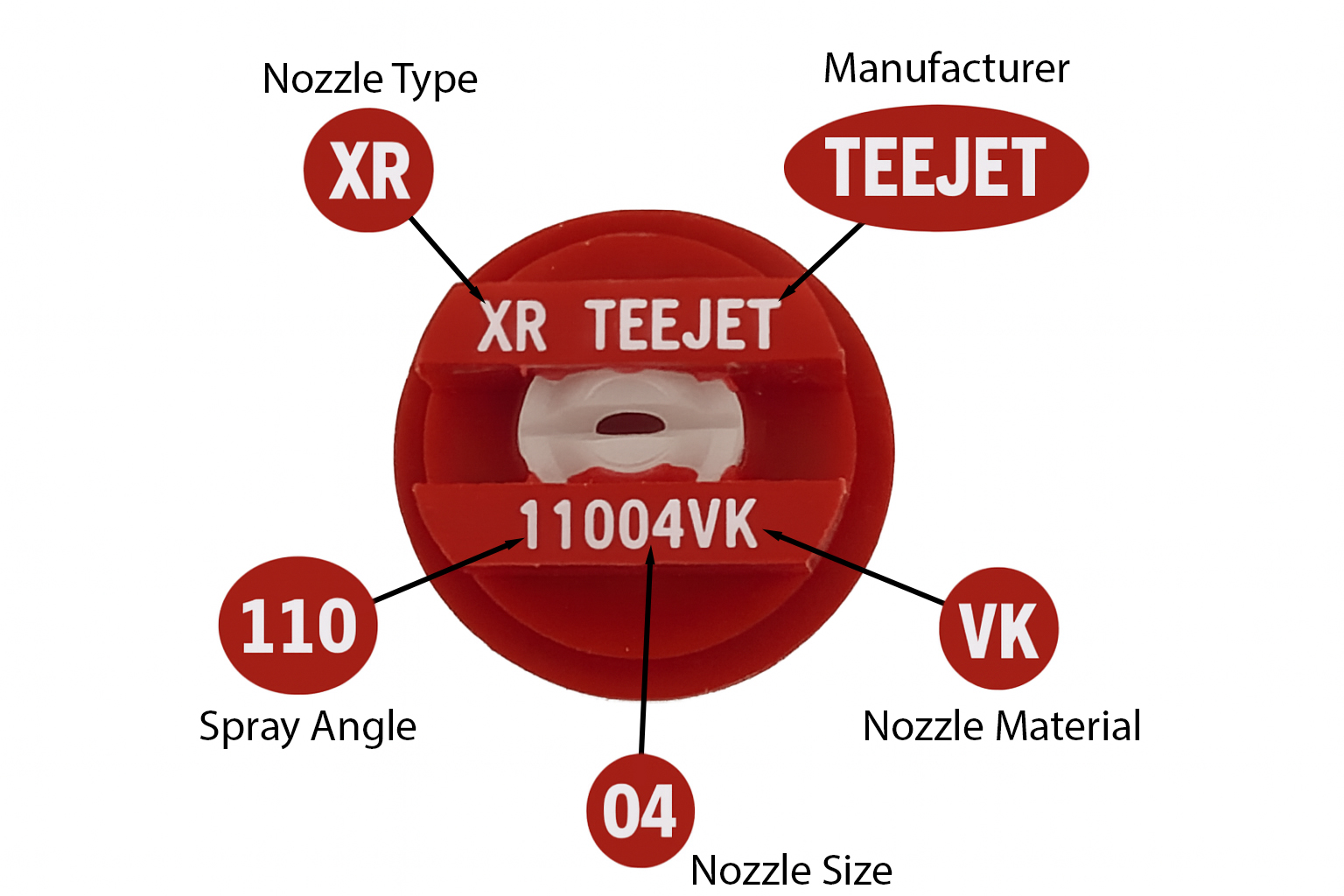


There may also be letters on your spray nozzle. These can refer to different things. In many cases, they will indicate the nozzle type/series, the nozzle material, and the manufacturer. 

Color Matters Too

The color of the nozzle will also tell you the flow rate. Thanks to ISO color coding, nozzle color indicates flow rate, regardless of the brand. This makes it easy to match or replace nozzles just by looking at the color and number together.

Not all types of nozzles fit this code, but the vast majority of flat fan, dual fan, and cone nozzles used on boom sprayers will follow this code. For more details, read our full guide to understanding nozzle numbers and coloring. It walks through examples and has charts showing the color/sizing code.


Selecting a Sprayer Nozzle

Choosing the right spray nozzle starts with understanding your specific application. Ask yourself: what pest are you targeting, where is it located, when and how are you applying, and what chemical are you using? These answers will guide your nozzle selection.

  • Always Refer to the Pesticide Label
    The label provides crucial guidance — including application rates, recommended nozzle types, droplet size, pressure, and legal requirements. It's not optional: the label is the law.

  • Match the Nozzle to What You’re Spraying
    Different products call for different tips. Herbicides usually work best with flat fan nozzles, fertilizers often need stream or flood tips, and fungicides may require finer coverage. Also, check material compatibility — stainless steel, ceramic, acetal, or polypropylene tips may perform differently depending on the chemical.

  • Consider Your Application Method
    Boom spacing, spray pattern, and operating pressure all influence nozzle choice. Most row crop sprayers use 110° flat fan nozzles at 15" or 20" spacing, while wider spacing or drift-sensitive applications may need specialty nozzles.

  • Evaluate Drift Potential
    Drift reduces effectiveness and increases risk to neighboring crops. Air-induction nozzles reduce drift by producing larger droplets. Your product label and nozzle charts will help you choose the correct droplet size and PSI range.

In short, nozzle selection isn’t one-size-fits-all. You must consider the right questions and refer to the pesticide or fertilizer label. This way you can find the nozzle that delivers accurate, effective, and compliant application.

We created a free tool that helps you walk through various factors and provide you with spray nozzle options that will meet your needs. This tool is a great starting point but you can always reach out with any questions. 


>Try out the nozzle Selector tool here!


Sizing Your Spray Nozzle 

Choosing the correct sprayer nozzle size is a vital part of the nozzle selection process. After you know the nozzle type you need. We need to calculate the proper size. Nozzle size refers to the flow capacity in GPM at certain pressure.  

The size you need is determined by your travel speed, nozzle spacing, and application rate (typically gallons per acre). When sizing your nozzle, you will need these three key pieces of info:

  1. GPA (Gallons Per Acre) – Your desired application rate
  2. MPH (Sprayer Speed) – Your average spraying speed
  3. Nozzle Spacing – The distance between nozzles on your boom (commonly 15” or 20")

This info is entered into this formula below and will provide the flow rate needed per nozzle:

GPA × MPH × Nozzle Spacing ÷ 5,940 = GPM per nozzle

You can learn more about using this formula in our guide to sizing spray nozzles. It provides examples and explains more of the nuance. You can also use our nozzle sizing calculator to find out what nozzle size you need at various speeds and application rates: 

>Use our GPM Calculator


Spray Nozzle Charts

Once you know the nozzle type and the size required, you must identify the nozzle size that will allow you to hit your target rate. This means understanding how to read a spray nozzle chart. These charts give you the key performance details for each nozzle—helping you match the right size and type to your application.

What You’ll Find on a Nozzle Chart

  • Flow Rate (GPM): How much liquid the nozzle puts out per minute at different pressures.
  • Operating Pressure (PSI): The pressure range where the nozzle performs properly.
  • Droplet Size: Spray quality category (Fine, Medium, Coarse, etc.) at different pressures.
  • Application Rate (GPA): Gallons per acre based on nozzle spacing and travel speed.

These numbers help you select a nozzle that applies the right amount of product, at the right pressure, and with the right droplet size for the coverage you need and drift control required

If you are new to nozzle charts and want to see more details, this guide will walk you through how to use a spray nozzle chart.


Nozzle Calibration, Wear & Maintenance

Even the perfect nozzle can deliver poor results if it’s not properly maintained or calibrated. Over time, nozzles wear out, affecting flow rate, droplet size, and overall spray performance. To stay effective—and compliant—you need to regularly check your nozzles and make sure they’re doing what they’re supposed to do.

Why Calibration Matters

Calibration ensures your nozzles are applying the right amount of product at the correct rate and pressure. Even small deviations in flow can mean overapplying or underapplying, which wastes product and reduces effectiveness. You should calibrate your sprayer every season—or anytime you switch products, change speeds, or adjust boom settings.

A simple way to check flow rate is to measure how much liquid each nozzle outputs over a fixed time and compare it to the nozzle chart. If it’s off by more than 10% from the expected rate, it’s time to clean or replace that nozzle.

How to Spot Nozzle Wear

Nozzles wear gradually, especially with abrasive fertilizers or pesticides. Worn nozzles often show signs like:

  • Uneven spray patterns
  • Excessive drift or misting
  • Reduced or increased flow rate
  • Visual damage or erosion on the orifice

It’s a good idea to keep a few new nozzles on hand for comparison. If the output or pattern from a used nozzle doesn't match the new one, it's likely worn and needs to be replaced.

Cleaning & Maintenance Tips

  • Avoid wire brushes or hard objects that could damage the orifice.
  • Use soft brushes or manufacturer-approved nozzle cleaning tools.
  • Flush your sprayer system with clean water after each use to prevent chemical buildup.
  • Inspect gaskets and caps for cracks or leaks during each cleanout.

Neglecting nozzle maintenance can lead to poor results—even with the right size, type, and pressure. A little time spent checking, cleaning, and replacing worn nozzles goes a long way in protecting your crop and your bottom line.


Final Word

Spray nozzles may be small, but they play one of the biggest roles in your sprayer’s performance. From selecting the right type and size to understanding spray patterns, droplet sizes, and application rates—every detail matters. 

By taking the time to learn how nozzles work, how to read charts, and how to maintain them, you’ll get better results in the field, reduce waste, and stay compliant with product labels. Whether you're just getting started or fine-tuning your setup, understanding your nozzles is the key to better spraying.


Choosing the Right Nozzle for Spraying Liberty® and Generic Glufosinate
(0) Choosing the Right Nozzle for Spraying Liberty® and Generic Glufosinate

Liberty herbicides and their generic alternatives present growers with a challenge: finding nozzles that balance coverage and drift control while staying within label requirements.

It’s a challenge we face, too. At Dultmeier, we understand spray nozzles—their droplet size, spray pattern, and flow rate—but many variables (chemical type, tank mix, rate, speed, weather) make it impossible to recommend a single nozzle for every situation.

Instead, our goal is to compile the best available information and help you choose the right setup for your needs.

This guide covers which nozzles can provide the droplet size needed for glufosinate (Liberty) use on U.S. corn and soybeans, backed by label requirements, university research, manufacturer guidance, and real-world feedback. As always, the label is the law—and it must be followed.


TL;DR: Key Takeaways for Liberty® Nozzle Selection

    • Liberty® requires medium to coarse droplets for full leaf coverage and drift control.

    • Nozzles like TeeJet AIXR, TT, TTJ60, and Greenleaf AirMix®, TurboDrop®, and TADF DualFan meet label specs when used correctly.

    • Application success depends on droplet size, pressure, boom height, speed, and GPA.

    • Always read the label, especially for generic glufosinate—crop and adjuvant approvals may differ.

Dultmeier Sales can help you size the right spray nozzle, but always consult the label and your agronomist for  product-specific recommendations.


Why Nozzle Selection Matters for Liberty®

Liberty® kills almost any plant it touches — including glyphosate-resistant weeds — but it only works where it makes contact. That means full coverage of weed leaves is essential. To get the job done right, you need a nozzle that provides excellent leaf coverage while minimizing drift, especially near non-LibertyLink® crops. 


What the Liberty® Herbicide Label Says

According to the Liberty® 280 SL label, you need to use a nozzle that has medium to coarse droplets:

“Apply with nozzles and pressure that deliver medium to coarse spray droplets as indicated in nozzle manufacturer’s catalogues and in accordance with ASABE Standard 572…”

Source: BASF - Label Liberty® 280 SL (I highly recommend reading to fully understand the requirements)

Understanding this, there are some logical follow-up questions:

  • What is a medium to coarse droplet?
  • Which spray nozzles are available to produce medium to coarse droplets? 

Let's break down the answer to each of these questions.


Understanding Droplet Size Requirements for Liberty® Herbicide

In the world of agricultural spraying, "medium" and "coarse" droplet sizes are defined by ASABE Standard S572.1, which classifies spray droplets based on their Volume Median Diameter (VMD)—the point at which half the spray volume consists of droplets smaller than the listed size and half are larger.

  • Medium droplets range from 226 to 325 microns in diameter.

  • Coarse droplets range from 326 to 400 microns.

Turbo TeeJet Nozzle Medium to Coarse Droplets Demo:


These sizes strike a balance between coverage and drift control—a critical factor when applying contact herbicides like Liberty®, which require even leaf surface coverage but also must avoid off-target drift, especially near sensitive crops.

For comparison:

  • Fine droplets (<225 microns) provide excellent coverage but drift easily.

  • Very coarse and larger droplets (>400 microns) are more drift-resistant but may lead to poor weed control if they don't cover the leaf surface adequately.

Want a deeper dive into how these droplet sizes affect spray performance, coverage, and herbicide effectiveness? Check out this detailed breakdown. It’s a must-read if you want to gain a thorough understanding of droplet sizes and how they affect your spray quality.


Nozzles That Deliver Medium to Coarse Droplets for Liberty® Application

There are several nozzles available that will produce medium to coarse droplets. The key is making sure that a nozzle series will produce this droplet size across the pressure range you operate and the nozzle size you use. 

Nozzle size affects the droplet size; larger sizes typically create a larger range of droplets relative to smaller sizes within the same family. Refer to the spray nozzle chart for a given nozzle type to understand this in more detail. 

BASF has provided specific nozzle types from TeeJet with guidelines for application. These are the nozzles that they are recommending to maintain the coverage needed to cover the plant tissue.


BASF Recommended TeeJet Nozzles:

Nozzle Brand

Nozzle Series

Sprayers with PWM Systems

TeeJet

Turbo TeeJet - TT

Yes

TeeJet

TTJ60 

Yes

TeeJet

AIXR

No

TeeJet

AITTJ60

Yes


Source: TeeJet Liberty Spray Tip Recommendations

Note: Dultmeier Sales does not endorse a specific nozzle for every application. The information provided reflects guidance from BASF and TeeJet Technologies. It is the responsibility of each applicator to understand the products they are using and to ensure all applications are made in full compliance with the product label.


Nozzles that Produce Medium to Coarse Droplets

Greenleaf and Wilger also offer nozzles for excellent coverage. The Greenleaf TurboDrop Dual Fan has been used very effectively with Liberty. There are also other good options. These nozzles listed below offer the medium to coarse droplet size called for when applying Liberty® and provide some drift control as well:

Nozzle Brand

Nozzle Series

Sprayers with PWM Systems

Greenleaf

TurboDrop Dual Fan - TADF


Greenleaf

Turbo Drop - TDXL


Greenleaf

Air Mix - AM


Greenleaf

Blended Pulse Dual Fan - BPDF

Yes

Wilger

ER Series

Yes

Wilger

SR Series

Yes


Follow Recommended Application Guidelines

In addition to the nozzle type, application practices are extremely important for drift reduction and coverage. Again, we can refer to what the label says. In this case, it covers several different factors:

Drift-Reducing Surfactants

  • "Addition of some drift retardants can significantly increase the droplet size and reduce spray coverage and efficacy. If a drift retardant is used, ensure that it is compatible for use with Liberty 280 SL and spray equipment being used."
  • Implication: Compatible drift agents must not compromise coverage.
    Source: Application Instructions section

Boom Height

  • "DO NOT exceed a boom height of 24 inches above target pest or crop canopy... Set boom to lowest effective height... Excessive boom height will increase the potential for spray drift."
  • Implication: Lower boom height reduces drift and improves spray pattern.
    Source: Spray Drift Mitigation section

Spray Speed

  • While spray speed isn’t explicitly named, the label does warn against boom bounce and turbulence:
    "Boom should remain level with the crop and have minimal bounce."
  • Implication: Excessive ground speed increases turbulence and bounce, raising drift risk. Generally, speeds above 10 Mph can greatly increase drift with non-air induction flat fan nozzles.
    Source: Spray Drift Management section

Pressure

  • "Use the lower spray pressures specified for the nozzle. Higher pressure reduces droplet size and does not improve canopy penetration... Use a higher-capacity nozzle instead of increasing pressure."
  • Implication: Lower pressure = bigger droplets = less drift, but may reduce coverage.
    Source: Techniques for Controlling Droplet Size

Droplet Size and Coverage

  • "The most effective way to reduce drift potential is to apply large droplets...."
  • "Liberty 280 SL is a contact herbicide and requires proper nozzles with uniform, thorough spray coverage to achieve optimum weed control."
  • Implication: Medium to coarse droplets balance drift and coverage.
    Source: Advisory Spray Drift Language & Spray Droplet Guidance 


Application Guidelines for Liberty Herbicide:


University Research: What the Experts Say About Nozzle Selection for Liberty®

When it comes to applying Liberty® (glufosinate) effectively, university research clearly supports what the product label already emphasizes: droplet size matters—a lot.

Medium to Coarse Droplets Are a Must

Because Liberty is a contact herbicide, every leaf surface needs to be covered for the product to work. The University of Minnesota Extension states that “proper nozzle selection and carrier volume are key in achieving adequate spray coverage,” reinforcing the label’s requirement for medium to coarse droplets during application. These droplet sizes help ensure good coverage while also minimizing drift.

This message is echoed by Iowa State University, which highlights that using the right nozzle and enough water volume is critical for optimizing glufosinate performance.

Coarse Droplets Can Still Deliver Results

Don’t assume bigger droplets mean poor performance. Field trials from the University of Nebraska found that even with coarse droplets (~600 microns) and a low carrier volume of 5 GPA, Liberty was still able to achieve around 90% of maximum weed control, all while reducing drift potential. That said, increasing GPA (e.g., 15–20) further boosts consistency.

Generic Liberty® Alternatives

Other generic products that contain the same active ingredient, glufosinate-ammonium, provide their own guidelines on application. When using generic versions of Liberty herbicide, always read the label carefully—some products may not be approved for all LibertyLink crops. 

While most generics share similar droplet size and drift control requirements with Liberty, it's important to confirm these details on the label. Also, surfactant and adjuvant recommendations can vary, so check compatibility with tank mix partners before spraying.

Key Takeaways

Choosing the right spray nozzle for Liberty® herbicide is key to getting effective weed control while avoiding drift. As a contact herbicide, Liberty requires full leaf coverage—achieved with medium to coarse droplets as specified on the label.

Research and field experience show that droplet size, pressure, boom height, speed, and water volume all affect results. Nozzles like TeeJet’s AIXR, TT, and TTJ60 or Greenleaf’s AirMix®, TurboDrop®, and TADF DualFan can hit the right droplet range when used properly.

If you're using a generic version of glufosinate, always read the label—crop approvals and adjuvant recommendations may vary.

Bottom line:

  • Follow the label—it’s the law.
  • Use nozzles that produce medium to coarse droplets.
  • Use the right GPA and boom height for good coverage and low drift.
  • Check compatibility for surfactants, tank mixes, and generics.

At Dultmeier, we specialize in sizing spray nozzles for conventional and PWM systems.  For help, call us and we can explain the droplet size and spray pattern that any given nozzle will do; however, we are not experts on the herbicides or tank mixing methods themselves. Be sure to consult the product label and an agronomist for more guidance. 

Shane Blomendahl, Author

Tech Ag & Industrial Sales

Shane Blomendahl is a tech sales veteran at Dultmeier Sales with over 10+ years of experience in liquid handling products covering several industries and applications.

Learn More About the Author

Sprayer Pressure Calculator: Discover the Right Operating PSI
(0) Sprayer Pressure Calculator: Discover the Right Operating PSI

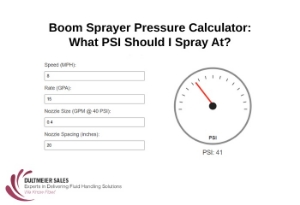
If you're wondering what pressure you should run your sprayer, this calculator can help. By entering your speed, application rate, nozzle size, and spacing, you'll get an estimate of the system pressure needed to achieve your desired spray coverage. It's a quick way to figure out what size nozzle can provide the pressure range needed for your application. You can also discover how changing your speed, rate, and nozzle can affect your operating pressure. 


Boom Sprayer Pressure Calculator


PSI
PSI:


How to Use the Boom Sprayer Pressure Calculator

This tool helps you estimate the pressure your sprayer system needs to operate based on your speed, desired application rate, nozzle size, and nozzle spacing. To use it: Enter your travel speed in miles per hour (MPH). Enter your target application rate in gallons per acre (GPA). Input the nozzle size — this should be the flow rate in gallons per minute (GPM) at 40 PSI (check your nozzle chart). Set your nozzle spacing in inches — the distance between each nozzle on your boom. As you adjust the inputs, the pressure gauge will update in real time to show your estimated required system pressure in PSI.

⚠️ Note: This calculator is designed to serve as a general guide for estimating system pressure. It assumes ideal conditions and consistent operating parameters, but real-world factors can vary widely. 


How This Tool Helps in Spray Nozzle Selection 

With this tool, you see the operating pressure range of a nozzle when used for various applications. This helps you to ensure that a nozzle can handle a certain range of operating speeds. You can also find out if a certain size nozzle will allow you to spray at different rates and still be within the effective pressure range of the nozzle, or if you need to select a larger nozzle size or slow down. 

For more help selecting a sprayer nozzle, refer to this tool that helps you identify nozzles that will work for various scenarios such as systemic herbicides, contact herbicides, post-emergence spraying, PWM systems, and more.


>>> Find the right nozzle for your boom sprayer! <<<


Pressure doesn’t just affect flow — it also impacts droplet size, which in turn influences:

  • Penetration: Smaller droplets at higher PSI may reach deeper into dense canopies.

  • Drift: Fine droplets are more likely to drift off-target; larger droplets are more stable.

  • Coverage: Fine droplets provide more surface area coverage; coarse droplets are better for contact herbicides or drift-sensitive situations.

So, when selecting a nozzle, consider both the flow rate and the droplet spectrum it produces at your operating pressure. This calculator helps by giving you that PSI estimate upfront — simplifying the process of matching a nozzle to your actual spraying conditions.


Understanding the Relationship Between Pressure, Speed, and Volume

Sprayer performance is influenced by three key variables:

  • Speed: The faster you travel, the more ground you cover per minute, so your sprayer must output more liquid to maintain the same application rate.

  • Application Rate (GPA): This is how much product you want to apply per acre. Higher GPA means more liquid is needed, which increases flow rate and may increase required pressure.

  • Nozzle Flow Rate: Each nozzle has a defined output (GPM) at a given pressure. The pressure must be adjusted to achieve the flow rate needed to match your speed and GPA.

The formula behind this tool calculates the necessary GPM per nozzle, then estimates the pressure needed to produce that flow based on your nozzle’s rating at 40 PSI.


More Spray Nozzle Resources:

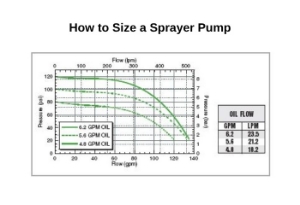
How to Size a Sprayer Pump: Flow, Pressure, and Pump Type Explained
(0) How to Size a Sprayer Pump: Flow, Pressure, and Pump Type Explained

Pump “size” can mean a lot of different things: Flow rate, port size, horse power required, or just how much space does the sucker take up! So when you are looking for a sprayer pump, you must consider several factors. But don’t worry, it is not complicated, and this article will provide the answers you need. 


Key Takeaways (TL;DR): Sizing a Sprayer Pump

Don’t just guess when picking a sprayer pump. Start by figuring out your flow rate (nozzles × GPM), then add 25–30% to handle things like pressure loss, agitation, and future upgrades. Make sure your pump can handle the pressure too—tree spraying needs way more PSI than a spot sprayer. Whether you’re running a boom sprayer, de-icer, or handgun rig, matching the pump to your setup means better performance, less wear, and fewer surprises in the field.


Identify Your Sprayer Type

First, you need to understand the needs of the specific type of sprayer you’re using—whether it's for tree spraying, agriculture, de-icing, or anything else—this is the first step. Sprayer type will inform you of the pump type you will need, as well as both the pressure and flow rate that is required. After all, not all sprayers will require the same fluid and pressure output. 

Typical Flow & PSI Requirements for Different Sprayer Pump Types:

Sprayer Type

Flow Range (GPM)

Pressure Range (PSI)

Boom Sprayer

1-100

15-120

Boomless Sprayers

3-100

20-60

Spot Sprayers

1-5

15-60

Tree Sprayers

10-50

150-700

De-Ice Sprayer

50-200

15-60

These amounts are general ranges for common sprayers and can vary. For a detailed breakdown, you can refer to our guide on the different types of sprayer pumps.


Calculate the Required Flow Rate

Once you know what type of pump you will need for your sprayer, you can then determine the size of the pump in regard to flow rate. To determine the required flow rate, you need to know some pieces of information. These pieces of information will vary slightly, depending on the type of sprayer, which again is why you start by determining what sprayer type you have.


Calculating Flow Rate for a Boom Sprayer

Flow requirements for your sprayer boom depend upon both the number of nozzles on the boom and the size of the nozzles. Once you identify the size of each nozzle or the flow rate per minute of each nozzle, you need to take that flow rate and multiply it by the total number of spray nozzles.  

number of nozzles on sprayer boom

Boom sprayer nozzles typically follow a color code. This will tell you the nozzle flow rate at various PSI. You will want to use the nozzle flow rate at the higher end of its operating pressure range. If you don’t yet have your nozzles sized or are uncertain what size nozzles you have, this guide will show you how to identify nozzle sizes. Then you can examine the nozzle chart for flow rates a various PSI.

If you have a “boomless” sprayer, the process is no different, although you may only have one or two nozzles. Likewise, a spot sprayer or spray rig with a single spray gun would only have one nozzle to account for.

Example Calculating Required Sprayer Boom Flow Rate:

Let's look at an example: if your sprayer boom has 18 nozzles that have a flow capacity of 0.4 GPM (gallons per minute), you will take 0.4 x 18. This gives us 7.2 gallons per minute. So we need a pump that is capable of delivering this flow rate; however, we are not done yet. We still need to examine some other factors.


Account for Pressure Increase

Multiplying the number of nozzles by their GPM capacity gets us started — but that alone often isn’t enough. Here's why we will need to consider more than just flow:

Extra Capacity for Increases in Travel Speed

If you speed up in the field but don’t change your nozzles, your sprayer must push more liquid through them to maintain the same application rate (gallons per acre). That means your system needs a higher flow rate — and your pump has to keep up. If the pump is undersized, pressure will drop, coverage may become uneven, and application rates may fall below label requirements.

Higher Application Rates = Higher Flow Demand

What if you need to apply a higher application rate in the future (GPA)? This will either require more pressure or a slower travel speed. However, this limits the sprayer. You can only increase pressure or decrease speed so much before needing to swap out your nozzles for larger ones.

Larger nozzles will directly increase how much fluid the pump must deliver. If you change nozzles to increase your rate, you won’t want to need to change out your pump as well. Account for this upfront, and you can be confident your sprayer will handle any future jobs.


ag boom sprayer


Account for System Losses and Bypass

Don’t forget that sprayer systems often use bypass regulators or agitation systems that recirculate fluid back to the tank. This “extra” flow also comes from the pump and needs to be accounted for.

A good rule of thumb: add 20–30% over your calculated nozzle GPM to accommodate system losses and agitation. Do note, if you use the same sprayer for two or three applications that require very different flow rates, figure 20-30% above the job that demands the highest flow rate. 

Now, this is a rule of thumb. The best route is to research the nozzles, the agitation jets, rinse nozzles, bypass valves, etc. Understanding the flow requirements for the boom as well as all the other accessories on the sprayer, will help to ensure you pick a large enough pump without unnecessarily oversizing it. 


Pump Type: Determine Pressure Required

The other half of sprayer pump performance to consider is pressure. The flow requirement tells us the output we need from the pump; however, the pressure required will tell you the type of pump you need. 

Boom sprayers and spot sprayers are going to be considered low-pressure applications. This would be about 15-120 PSI. Centrifugal pumps, roller pumps, and 12V diaphragm pumps will meet this requirement. 

Centrifugal pumps offer the highest volume. They are very common on larger agricultural boom sprayers as well as de-ice sprayers. 12V diaphragm pumps are used solely for low-volume applications such as small boom sprayers and spot sprayers. 

Sprayers where you need to reach a great distance with a spray gun will require more pressure. This is especially important for reaching tall trees. Engine-driven diaphragm pumps offer not only the flow but also the high pressure required to spray fluid 40-50 feet or even more. Typically reaching a pressure of 500 PSI or more.  


Our sprayer pump guide will break down each of these pump types in greater detail and offer you specific examples of each pump type for various applications.


Specific Sprayer Pump Sizing Examples

Let’s look at a few real-world examples to show how pump sizing works in practice:

Pull-Type Boom Sprayer Pump Sizing

Scenario:

  • Fifty-foot wide boom with 30 nozzles
  • Plan to spray 10 GPA rate at about 6 MPH
  • Nozzle size required: Yellow nozzle = 0.2 GPM @ 40 PSI.

Step 1: Calculate total nozzle output
30 nozzles × 0.2 GPM = 6 GPM

Step 2: Add margin for system demands
6 GPM × 1.3 (buffer for agitation, speed fluctuation, etc.) = ~7.8 GPM

Step 3: Consider an increase in rate or speed
15 GPA rate at the same speed would require 0.3 gallons per minute per nozzle. This can be achieved with the same nozzles at higher pressure or with a larger nozzle (Blue nozzle = 0.3 GPM at 40 PSI). 

  • 30 nozzles x 0.3 GPM = 9 GPM.  9GPM x 1.3 buffer = 11.7 GPM. 

Pump Recommendation: A Pump capable of 12 GPM at normal operating speed would work for these scenarios. Most agricultural sprayers use centrifugal pumps, and these are easily going to produce this amount, often much more. This would make the sprayer very versatile for higher volumes, such as applying fertilizer.


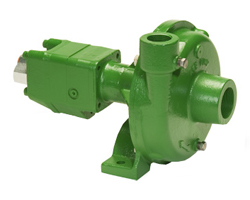
Examples: Ace FMC-HYD-204


Tree Spray Rig Pump Sizing 

Scenario:

  • High-pressure tree spraying with a hand gun
  • Spraying trees 40-45 ft tall
  • Required GPM: 10
  • Required PSI: 500

Step 1: Calculate total output
1 × 10 GPM = 10 GPM

Step 2: Add buffer for pressure loss and surge
10 GPM × 1.3 = ~13 GPM

Recommended Pump: 12–15 GPM diaphragm pump capable of 500+ PSI.


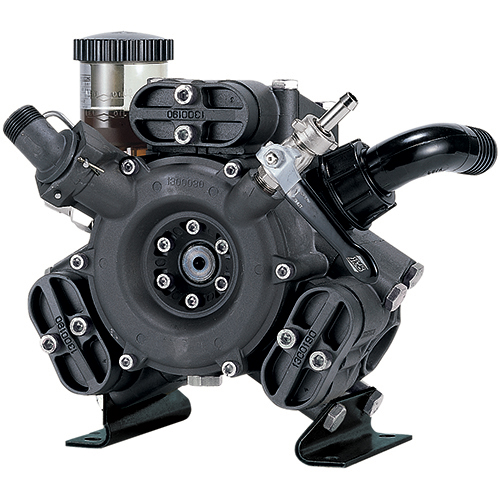
Examples: Udor Kappa 55, - AR503, - AR50


Spot Sprayer Pump Sizing

Scenario:

  • Small ATV sprayer
  • Handgun use only
  • Nozzle uses 0.5 GPM at 40 PSI

Step 1: Total output = 0.5 GPM
Step 2: Add a small buffer for pressure regulation
0.5 x 1.3 = ~.65 GPM

Recommended Pump Size: 1.8 GPM 12-volt diaphragm pump. There are 12V pumps that are lower in flow and cost; however, they are limited in pressure and may not provide the spray distance you need. So in this case, we over-size the pump slightly to ensure it performs. 


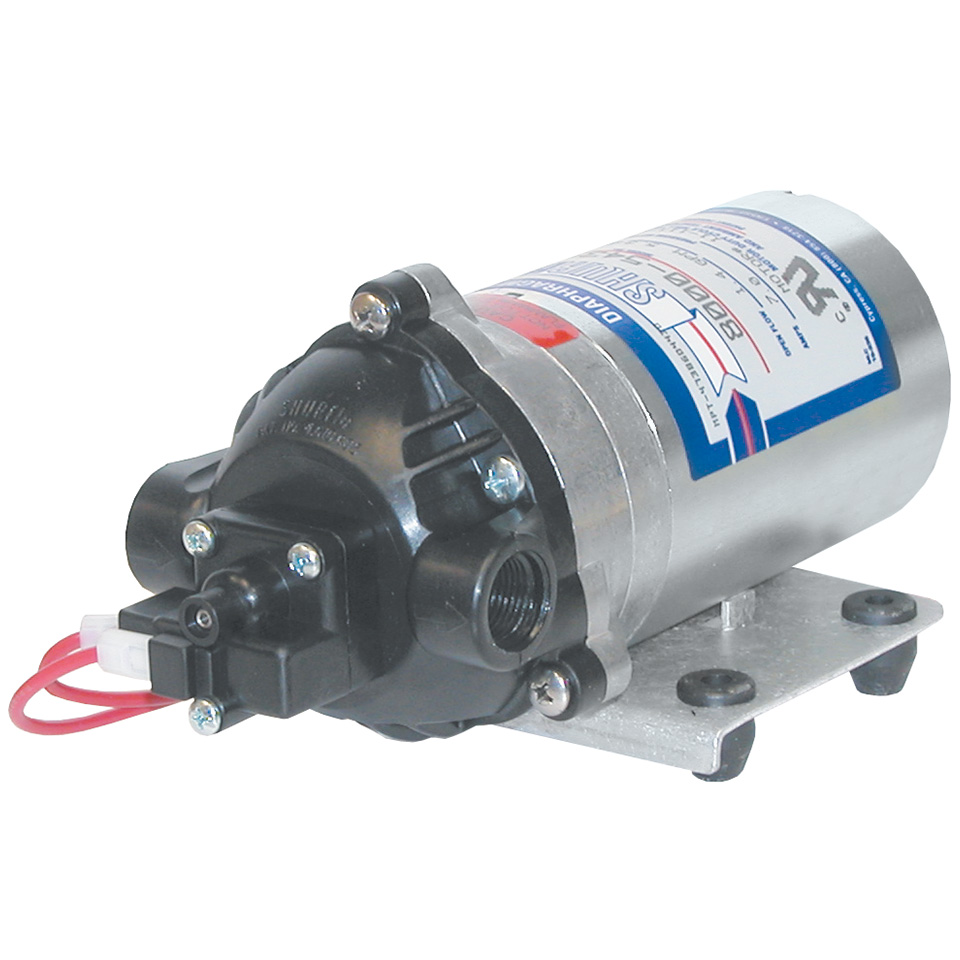
Example: Shurflo 8000-543-236


Conclusion

Getting the right size pump for your sprayer isn’t just about performance—it helps your equipment last longer and work more efficiently. When you take the time to calculate your flow rate, consider your pressure needs, and match it all to the right pump type, you’ll set yourself up for reliable, consistent spraying. A little planning up front goes a long way in making sure your sprayer does its job without headaches.


Shane Blomendahl, Author

Tech Ag & Industrial Sales

Shane Blomendahl is a tech sales veteran at Dultmeier Sales with over 10+ years of experience in liquid handling products covering several industries and applications.

Learn More About the Author

TeeJet Nozzle Charts: Find the Right Spray Tip for Your Application
(0) TeeJet Nozzle Charts: Find the Right Spray Tip for Your Application

TeeJet offers a wide range of sprayer nozzles, each designed for specific applications, including herbicides, fungicides, fertilizers, and more. Selecting the right one is vital; that's why the TeeJet nozzle charts are so important. 

These nozzle charts will show the flow rates, pressure ranges, and droplet sizes produced by a given TeeJet nozzle. Depending on the nozzle type, it may also show the gallon per acre rates that the nozzle can provide at various travel speeds and nozzle spacings. 

Whether you're looking at the XR Extended Range, AIXR air induction, TT Turbo TeeJet, or TTI low-drift series, we have the specific TeeJet spray nozzle chart you need to determine the correct type and nozzle capacity you need. 

Access Charts for Various TeeJet Nozzles

Use the interactive tool below to access the exact TeeJet nozzle chart PDF for your spray tip. Whether you're calibrating for herbicides, fungicides, or fertilizers, this tool helps you match your nozzle type with its official chart so you can get precise flow rates, droplet sizes, spray angles, and operating pressures.


TeeJet Nozzle Chart Tool


Note: some of the links to chart PDFs have more than one nozzle chart on them, and you may need to scroll down. 

How It Works:

  1. Select your TeeJet nozzle type from the dropdown menu.

  2. Instantly view the chart as an image or access the TeeJet nozzle chart PDF.

  3. Click through to purchase either the spray tip only or a complete tip/cap/gasket assembly—all directly from Dultmeier.com.

Supported Nozzle Types:

You can view charts and shop parts for the following TeeJet nozzles:

This tool is a fast and easy way to locate accurate spray data without flipping through a catalog. Whether you're in the shop, in the cab, or out in the field, pull up the TeeJet nozzle chart PDF for your tip and make informed spraying decisions in seconds.


How to Read a TeeJet Nozzle Chart

Each TeeJet nozzle chart includes several key pieces of information to help you select the right spray tip for your application. Here's what each one means:

  • Tip Number (e.g., XR11002): This identifies the nozzle type, spray angle, and flow rate. For example, “XR” stands for Extended Range, “110” is the spray angle in degrees, and “02” refers to the flow rate size. You can learn more about nozzle numbers and color codes in this guide.

  • PSI Range: The recommended pressure range (in pounds per square inch) for optimal performance. Staying within this range will ensure that you maintain the spray pattern and get adequate coverage and droplet size.

  • GPM Flow Rate: Gallons per minute the nozzle delivers at specific pressures. This is critical for calibration and ensures you're applying the correct volume. If you need a refresher on nozzle sizing, be sure to read this article, where we break down the formula for sizing nozzles.

  • Droplet Size Category: Indicates the size of the spray droplets—such as Fine, Medium, Coarse, or Extremely Coarse—which affects coverage, drift potential, and suitability for different chemicals. 


Spray Nozzle Selection

If you're still exploring which nozzle is best for your application, be sure to check out our TeeJet Spray Nozzles overview. That guide breaks down the different nozzle types we carry, what each one is designed for, and how they compare—making it a great companion to the nozzle chart tool on this page.