RSS

Blog

Flowserve PH6 Pump Discontinued - Replaced by CT6 Pump
(0) Flowserve PH6 Pump Discontinued - Replaced by CT6 Pump

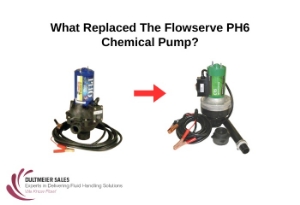
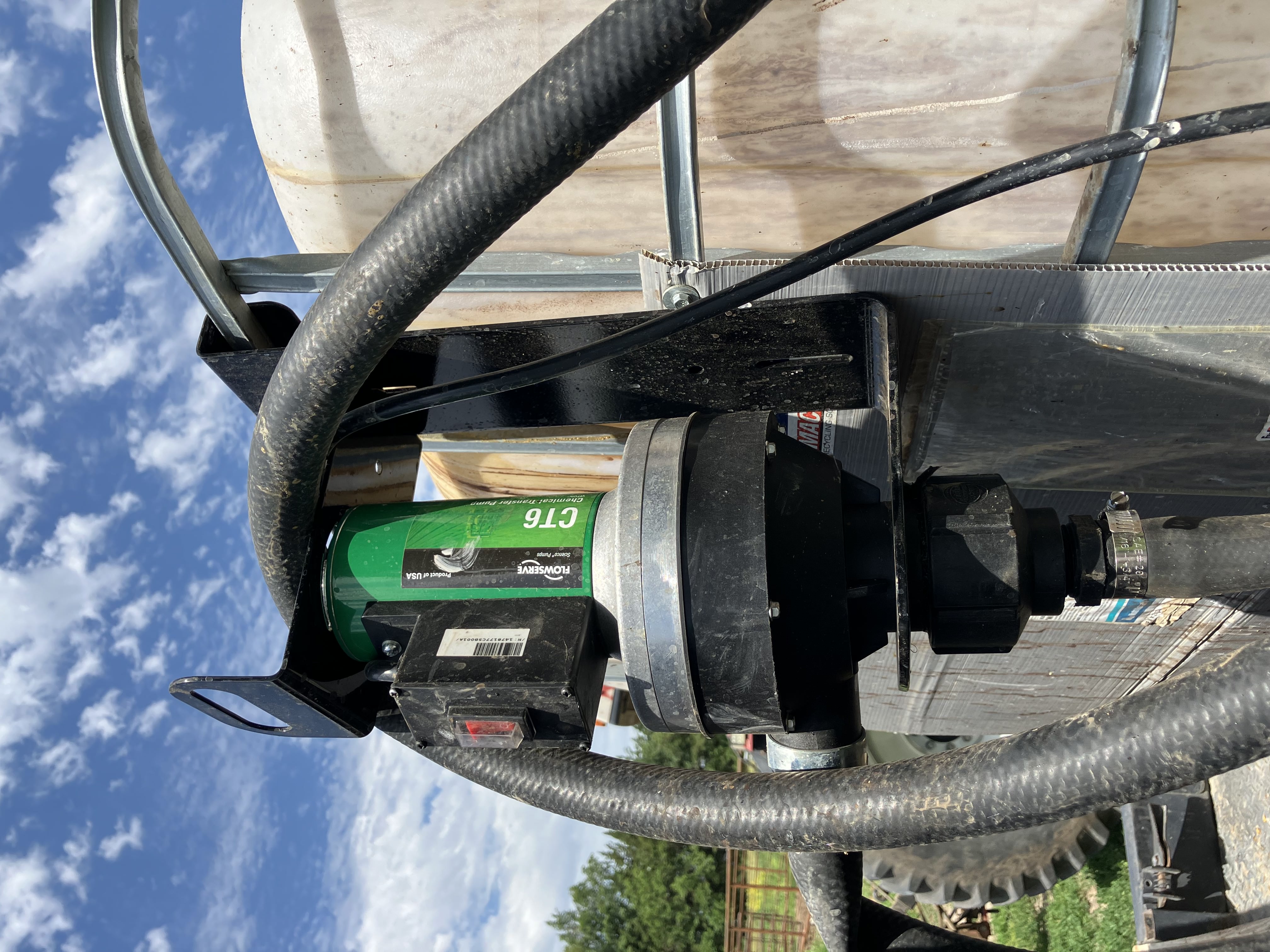
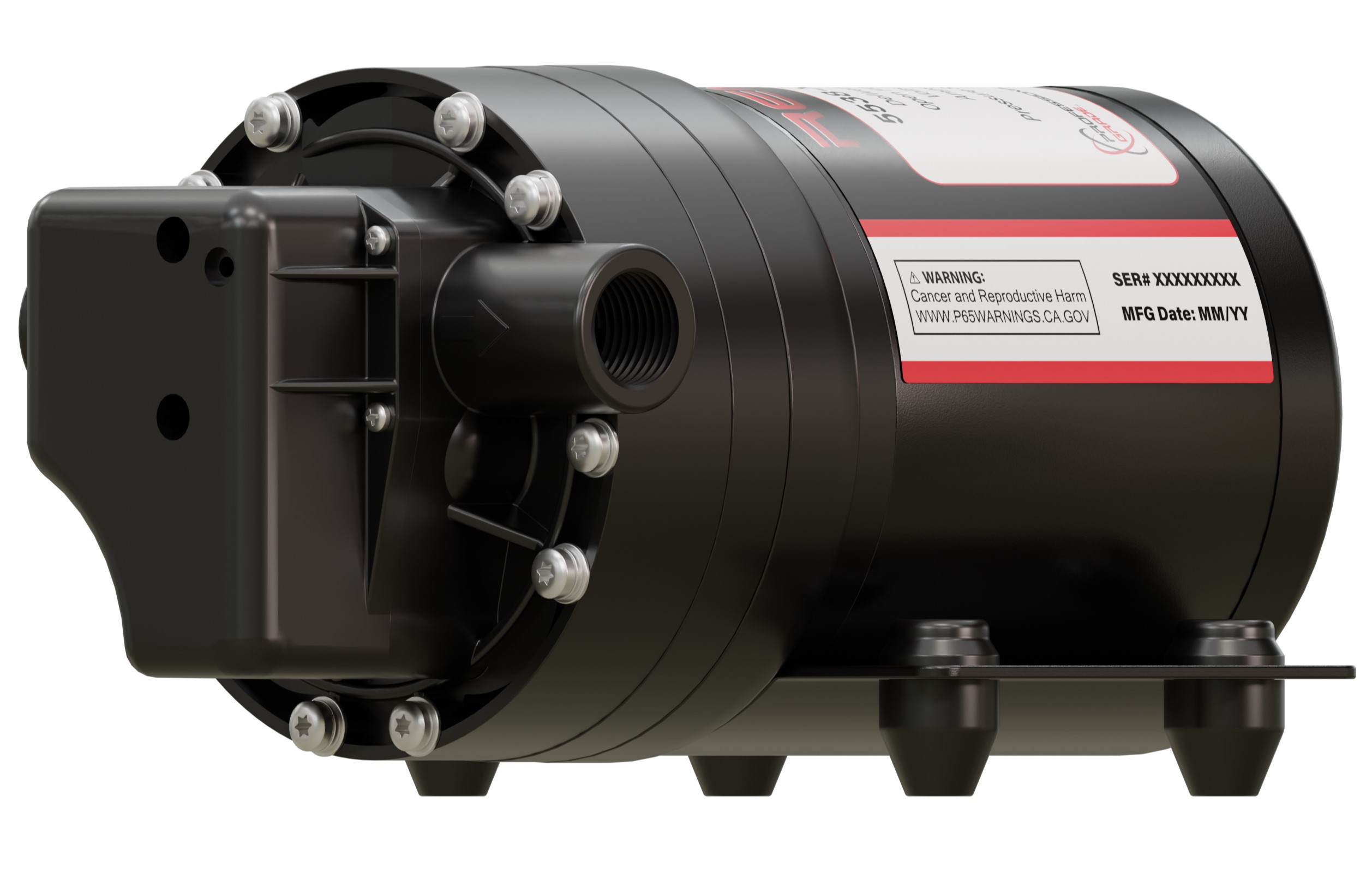
The Flowserve PH6 Pump was a widely used pump for ag chemicals. It has now been discontinued and replaced by the Flowserve CT6 Pump. Unfortunately, the manufacturer is no longer making repair parts for the PH6 pumps, but the new CT6 pump offers improved performance and serves as a direct replacement.  


CT6 Chemical Pump


Are the CT6 Pump & PH6 Pump the Same? 

The CT6 series of chemical pump is interchangeable with the PH6 pump. You can drop it in and use the same hose, meters, nozzles, or suction tubes. The change from PH6 to CT6 offers enhanced performance. The CT6 pump provides flow rates of 13 gpm (CT6) or 18 gpm (CT6 HF). The PH6 pump was rated for just 10 gpm.

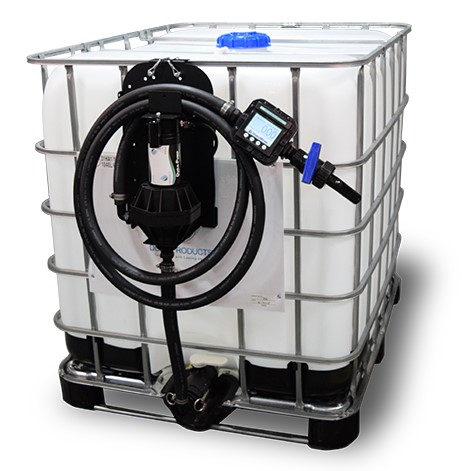
CT6 pumps are available as 12-volt or 115-volt pump only, or in a pump/meter/bracket kit to hang on cage tanks or chemical tanks. It is also available in a portable caddy kit featuring a roll cage.

Key Features of CT6

  1. Enhanced Flow Rates: The CT6 Standard Model delivers up to 13 GPM, the CT6-HF model delivers up to 18 GPM, surpassing the PH6's maximum of 10 GPM, enabling faster chemical transfers.

  2. Improved Chemical Compatibility: With wetted parts made from glass-filled polypropylene, Santoprene™ diaphragms, and options for EPDM or Viton® seals, the CT6 is designed to handle a broader range of agricultural and industrial chemicals.

  3. Integrated Bypass Valve: An internal bypass valve protects the pump and motor by relieving pressure and recirculating flow internally if a discharge valve is closed during operation.

  4. Self-Priming and Dry-Run Capability: The CT6 is self-priming and can run dry without damage, reducing the risk of chemical exposure to operators.

  5. Ease of Maintenance: The CT6's design includes a removable cartridge containing the diaphragm, valves, and bypass assembly, simplifying field maintenance and part replacements.


Check Out All CT6 Chemical Pump Packages

CT6 12- or 115-Volt Pump Only

Pump and Meter Kits for Cage Tank

Sprayer Nozzle Selector Tool – Find the Best Nozzle for Your Application
(0) Sprayer Nozzle Selector Tool – Find the Best Nozzle for Your Application

Use this Tool to Find Nozzles for Your Sprayer

Choosing the right sprayer nozzle is critical to achieving effective and efficient chemical application. Whether you're applying herbicides, fungicides, insecticides, or liquid fertilizers, your spray nozzle selection will directly affect droplet size, spray pattern, coverage, and drift control. That's why we created this interactive Spray Nozzle Selector Tool—to help you quickly identify nozzle options that meet your specific application needs.

Answer a few questions about your application and get recommendations on sprayer nozzles that will work for you!


Sprayer Nozzle Selector

Step 1 of 5


Notice: The spray nozzle recommendations provided by this tool are based on the inputs you’ve selected and are intended to offer the best general match for your application. However, actual results may vary depending on your specific equipment, spray mix, and environmental conditions.

Always follow the chemical label requirements and consult the manufacturer's guidelines when selecting and operating spray nozzles. For assistance with precise nozzle sizing or regulatory compliance, contact a qualified agronomy advisor.


Sprayer Nozzles and Spray Tips for Agricultural Spraying

At Dultmeier Sales, we carry a wide range of ag sprayer nozzles from top brands like TeeJet, Hypro, Wilger, and Greenleaf. Whether you're outfitting a boom sprayer, upgrading to PWM-compatible nozzles, or looking for low-drift spray tips, we've got the solutions you need.

Helpful Articles for Choosing the Right Nozzle

Looking to learn more? Explore our most popular blog posts designed to help you make the right nozzle choice:

Why Choose Dultmeier?

Dultmeier Sales has decades of experience supporting farmers, co-ops, and ag professionals across the United States & Canada. We provide:

  • ✔️ Trusted support from knowledgeable inside sales reps
  • ✔️ A full inventory of ag spray equipment in stock and ready to ship
  • ✔️ Leading nozzle brands and hard-to-find parts

Have questions? Contact us today—our experienced team is here to help.

12 Volt Sprayer Pump Guide: Determine the Right Pump For Your Needs
(0) 12 Volt Sprayer Pump Guide: Determine the Right Pump For Your Needs

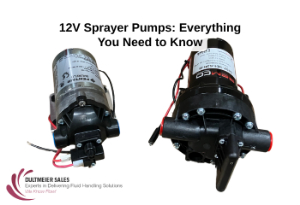
You see them everywhere and for good reason. A 12V diaphragm pumps provide the right combination of versatility, mobility, and affordability for several applications, including spraying, cleaning, low volume transfer, RVs, boats, etc.

These pumps are especially well-suited for use as sprayer pumps due to their compact size, 12-volt motor, reliable flow rate, and ability to handle water and chemical mixtures. They are commonly used on spot sprayers and boom sprayers mounted on ATVs, UTVs, and small tractors.

Understanding the various aspects of these pumps will not only help you to select the right one for your needs, but also ensure it keeps running for a long time. In the rest of this article, we will cover several topics:

  • How a 12V Pump Works: A quick look at how these compact diaphragm pumps move liquid and the different types available.
  • Key Features to Look For: Examining the different features and how to select the right pump for your application.
  • Installation: Guidance on how to properly install a 12V diaphragm pump for optimal performance.
  • Maintenance for Long-Term Performance: Simple practices to keep your pump running smoothly season after season.

If you would like to gain the knowledge you need to avoid problems with your 12V spot or boom sprayer pumps, then keep reading!

Understanding How a 12V Sprayer Pump Works

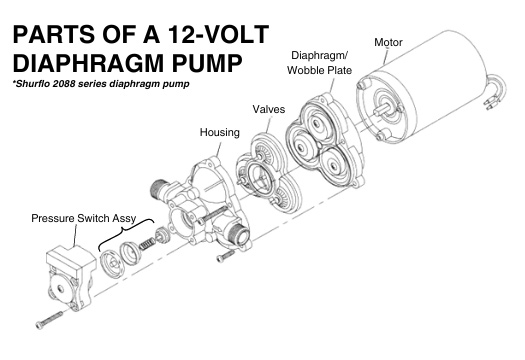
There are many types of 12V pumps, but the ones used on sprayers are simple in design. They consist of five basic components:

  • Motor
  • Pump Housing
  • Wobble/Diaphragm Plate
  • Check Valve Assembly
  • Pressure Switch

In a diaphragm pump, the wobble plate is the key to moving the fluid. Driven by the motor, this offset plate wobbles as it spins and flexes the diaphragm back and forth. As the diaphragms move, they create suction to pull fluid in through check valves, then push fluid out. 

Many models include a built-in pressure switch, so the pump automatically shuts off when the spray gun or boom valves are closed. This simple but effective mechanism makes 12V diaphragm pumps ideal for spot sprayers, boom sprayers, and even foam markers in agricultural, lawn care, and pest control applications.

You can see a more detailed breakdown of 12V diaphragm pump parts (as well as other sprayer pump types) in our sprayer pump guide.  

12V Sprayer Pump Capabilities

Due to the typical operating pressure requirements and limitations of 12V motors a the diaphragm pumps used on sprayers deliver relatively low flow rates at the. Typically between 1-5 gallons per minute. This is suitable for spot sprayers and small booms with up to about 8 or 9 nozzles, depending on their size

These pumps are self-priming up to 8-10 ft, depending on the exact model. They can be run dry, that is, without any liquid passing through them. 


Which 12V Sprayer Pump is Best: Key Features to Consider

When buying a 12V diaphragm sprayer pump, here are the most important specifications and features to evaluate:

Flow Rate (GPM)

Measured in gallons per minute (GPM), the flow rate determines how much liquid the pump can move in a given amount of time. Common flow rates for sprayer pumps range from 1-5 GPM. 1-2 GPM is suitable for spot spraying. The volume required for a single spray gun will typically require less than 1 GPM. Some larger nozzles may allow more, but 1-2 GPM will cover most applications.

1-2 GPM Pump options for spot sprayers: 

3-5+ GPM for larger sprayers, boom spraying:

If you are not sure what size pump you need, there is a simple method to determine the gallon per minute flow rate you need. Count the number of nozzles on the boom, then determine their flow rate. The color of the spray nozzle will tell you the GPM they deliver at 40 PSI.  You can learn more about sizing your nozzles in our detailed guide. When you know the nozzle flow rate, you can multiply that by the number of nozzles. Then multiply this number by about 20% to account for increased pressure and agitation. This will let you know the flow rate you need from your pump. 

Pressure (PSI)

Pressure, measured in pounds per square inch (PSI), is a major factor in sprayer performance. Higher pressures typically equate to finer droplets, while lower pressures deliver coarser droplets. Also, a higher operating pressure will result in a greater output, in terms of GPM, than lower pressures with the same nozzle. Learn more about nozzle sizing in this guide.  

Most 12V diaphragm pumps for sprayers operate in the range of 40–60 PSI, with some models reaching up to 100 PSI or more.

Chemical Compatibility

12V diaphragm pumps are typically compatible with a variety of chemicals. Pumps equipped with Viton, EPDM, and Santoprene have good resilience when used for water and herbicide/pesticide mixtures. They can also handle several fertilizers and other liquids. Be sure to check with manufacturers or compatibility guides for more info. 

Automatic Pressure Switch

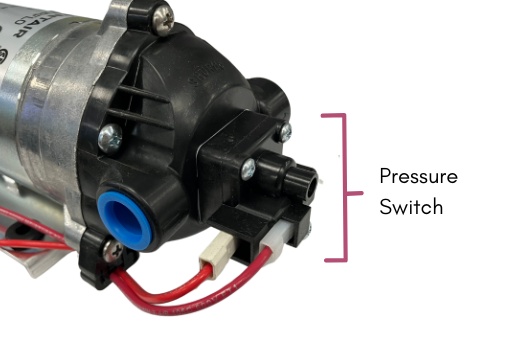
As referenced earlier, the pressure switch shuts off the pump motor when a set pressure is reached; when pressure drops, it starts the motor again. These pumps with a pressure switch are called “demand” pumps. 

This is a pretty standard feature on 12V pumps used on sprayers. Especially spot sprayers. It makes using a trigger wand/spray gun extremely convenient, the pump only runs when you pull the trigger. It helps extend the pump life and conserve battery.


12V pump demand switch location

Pumps with a pressure switch can experience cycling. This happens when a restriction in the system causes the pump to reach its shut-off pressure, resulting in rapid on-off pulsing. You will hear the switch clicking and see the pressure gauge jump repeatedly.

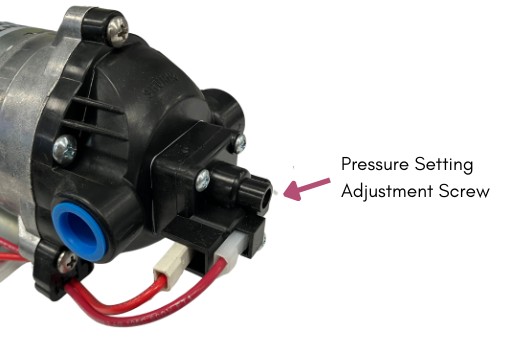
To avoid this, you want to size the pump appropriately for the task. Using a 4-5 GPM pump will provide too much flow for a single spray gun. This will certainly cause the pump to cycle on and off. A smaller pump, 1-2 GPM, is adequate. It may still cycle, but the pressure switch can be adjusted to ensure the pump runs smoothly. 


12V pump pressure switch adjustment screw location

For sprayers that do require larger pumps, it may be necessary to install a regulating valve. We will discuss this more in the installation section below. 

12-Volt Pump Run Time

Some 12V pumps can run continuously under ideal conditions, and some are not continuous-duty. This is because a 12V sprayer pump’s run time depends on pressure, heat buildup, and cooling

At lower pressures (under 40 PSI), pumps can often run continuously. At higher pressures, heat builds up faster, so limit run times to about 20-30 minutes with cool-down periods. Good ventilation helps extend run time, and stable voltage keeps the pump running efficiently.

Rapid cycling on and off from the pressure switch can cause the motor to get hot as well and put wear on the motor, and reduce run time. 


12V Pump Installation 

Proper installation is always an important factor for any pump. Fortunately, installation is straightforward for 12V sprayer pumps, with just a few fundamental guidelines to follow.

Mounting

The compact size of a 12V pump is one of its major benefits. It is easy to install almost anywhere. In many cases, the pump is light enough to be installed right on top of a poly tank. Because they are self-priming, they will pull liquid up out of the tank with no problem. 

Typically, you can mount a 12V sprayer pump horizontally, vertically, with the motor below, or with the motor above or below. The pump mustn't be installed in an enclosed space or near a source of heat such as an engine. The motor needs air circulation to keep cool. 

Electrical & Wiring

There are two important factors to consider: wire gauge and fuse size. First, the wire size you use should be at least the size of the lead wires on the motor. If the motor is going to be mounted far from the power source (20 ft or more), heavier wire is recommended. 

14-gauge wire is commonly adequate for most models, while larger motors, such as on the Remco “Fatboy”, would need 12-gauge wire. 


Second, a fuse should be installed on the positive wire between the pump motor and the power source. The fuse should be rated higher than the pump’s maximum current rating. For example, if the max amp draw is 18, use a 20 amp fuse.

Plumbing

When plumbing a pump for a pest control or herbicide sprayer, you should use a durable EPDM rubber hose. ⅜ inch hose is ideal for spot sprayers. If you are using a 12V pump on a planter for fertilizer, you should use a larger hose to reduce the friction loss and maximize your flow. 

You must install a strainer or screen on the inlet. This will protect the pump from debris. You can use a simple hose end strainer on the inlet of the suction hose inside the tank. It will prevent things like sand, grass, and other trash from getting pulled into the pump.

The downside of this screen type - it can plug over time and needs to be cleaned. A T-strainer will need to be cleaned out as well, but it can be installed on the pump inlet, outside of the tank, so it is easier to access.

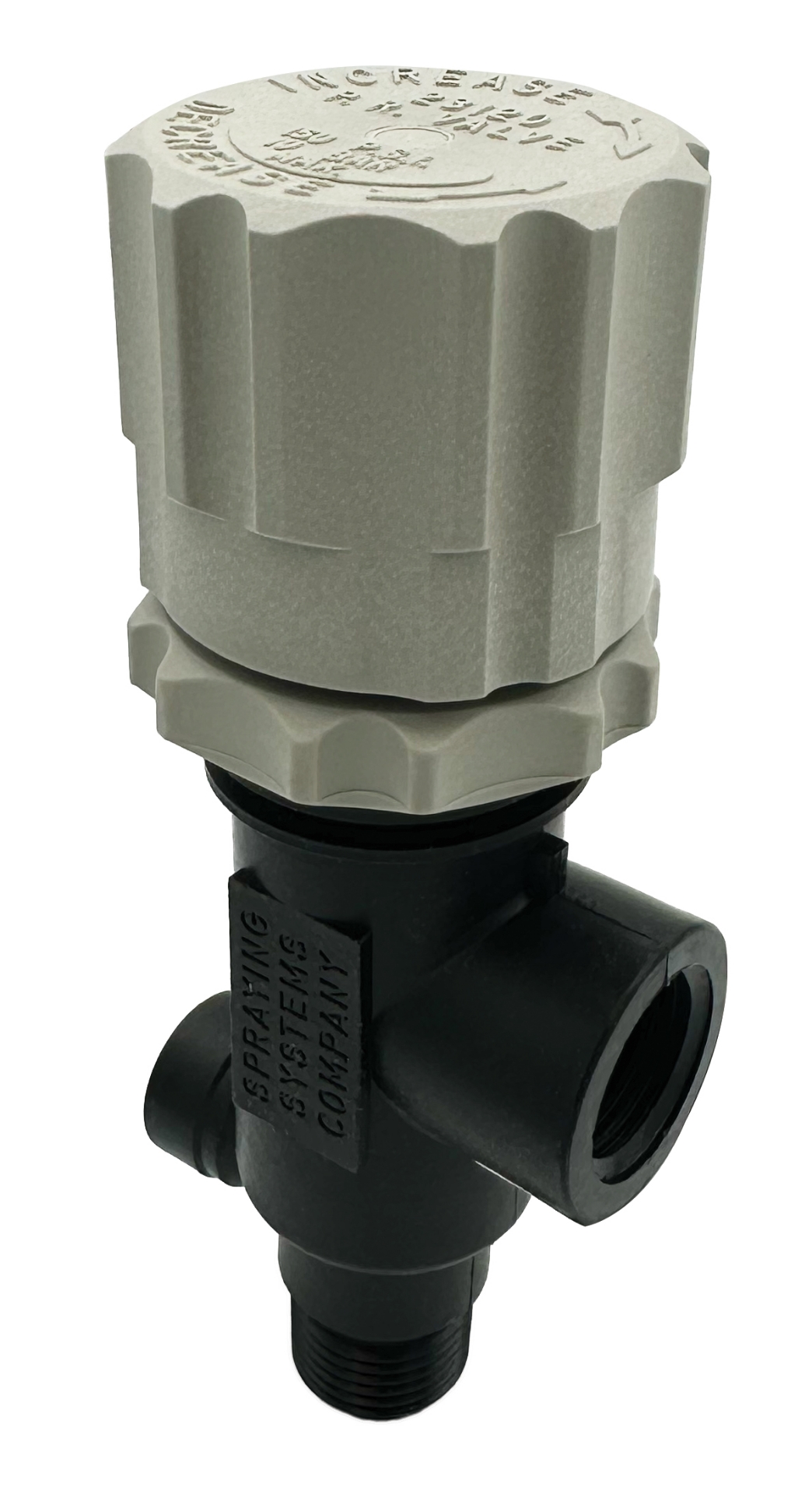
As mentioned earlier, 12V pumps with a demand switch can cycle, leading to overheating, motor damage, and premature switch failure. You can keep this from being a factor by installing a regulating valve on the discharge side of the pump. The valve can be used to adjust the operating pressure by increasing or decreasing the amount of fluid returned to the tank. 


TeeJet Pressure Relief Valve


The regulating valve, along with a pressure gauge, allows you to adjust the output of your sprayer. If you know your nozzle capacity at various pressures, and you can adjust your pressure, you can increase or decrease your application rate as needed.

Maintenance for Long-Term Performance

The most effective maintenance practice to prolong the life of your pump is to rinse fresh water through the system after each use. More damage to the internal pump components occurs when the pump is sitting around, not in use. Residual chemicals can corrode components and degrade diaphragms and valves. Fill the tank with clean water and run it through the pump and sprayer for a couple of minutes to flush out as much residual as possible. It is well worth your time. 

A clogged strainer can be a common cause of poor pump performance. Check the strainer screen periodically and clean with fresh water. If you notice a change in pump performance, be sure to check your strainer first. 

Additionally, at the end of each spray season, be sure to follow the recommended winterizing and storage guidelines. Freezing water left in the pump, hoses, or fittings can expand and crack components, especially delicate internal parts like diaphragms, valves, and seals. To prevent this, start by thoroughly draining the sprayer tank, pump, and all connected lines.

It’s best to run the pump briefly with clean water to push out any remaining chemical residue and moisture from the system. Once everything is drained, prepare a solution of RV antifreeze—this type is non-toxic and safe for pump systems. Fill the tank with enough antifreeze to circulate through the entire pump and plumbing system. Then, power on the pump and run it until the antifreeze exits from each nozzle or spray tip, ensuring it has reached every internal passage.

Once you’ve confirmed that antifreeze has been distributed throughout the system, turn off the pump and store the sprayer in a dry, sheltered location. Taking these steps will help you avoid costly repairs and ensure your sprayer is ready to go when spring returns.


Ready to find a 12V pump? Search our full inventory here.


Shane Blomendahl, Author

Tech Ag & Industrial Sales

Shane Blomendahl is a tech sales veteran at Dultmeier Sales with over 10+ years of experience in liquid handling products covering several industries and applications.

Learn More About the Author

Optimizing Your Chemical Inductor Setup: Using One Venturi for Multiple Tanks
(0) Optimizing Your Chemical Inductor Setup: Using One Venturi for Multiple Tanks

You are likely familiar with the concept of using a Venturi manifold with a single cone-bottom tank to inject chemicals into your sprayer or tender trailer tank. But one question we get is, "Can one Venturi manifold be used to pull chemicals from multiple cone-bottom tanks?"

The answer is yes. You can use one Venturi manifold (also known as an inductor assembly) and pull chemicals from multiple cone-bottom inductor tanks. This type of chemical mixing setup can be very beneficial. It can not only speed up your mixing process but also provide versatility as well.   

If you are going to implement multiple cone bottom inductor tanks with a single venturi, there are some key points to consider to ensure optimal performance. Let’s take a closer look at how to set it up effectively.


Benefits of Using Multiple Inductor Tanks

There are many reasons why using multiple inductor tanks would be a good option:

  • Decrease mixing time
  • Simplify your chemical mixing process
  • Handle products that don’t mix well together
  • Handle products that need a lot of time to dissolve
  • Pre-stage chemicals separately and add them one at a time into the carrier line
  • Easily swap between products or loads without rinsing a single inductor tank multiple times
  • Allow multiple operators to stage tanks simultaneously to reduce downtime


How to Set Up a Multi-Tank Chemical Inductor System with One Venturi Manifold

Before jumping into the details, it is helpful to understand the basics of how a chemical induction system with a venturi functions. If you want a detailed explanation, please refer to our guide on chemical inductors, but the basic principle is that adequate flow from a centrifugal transfer pump through the venturi will create suction that pulls in liquid from a cone bottom tank.


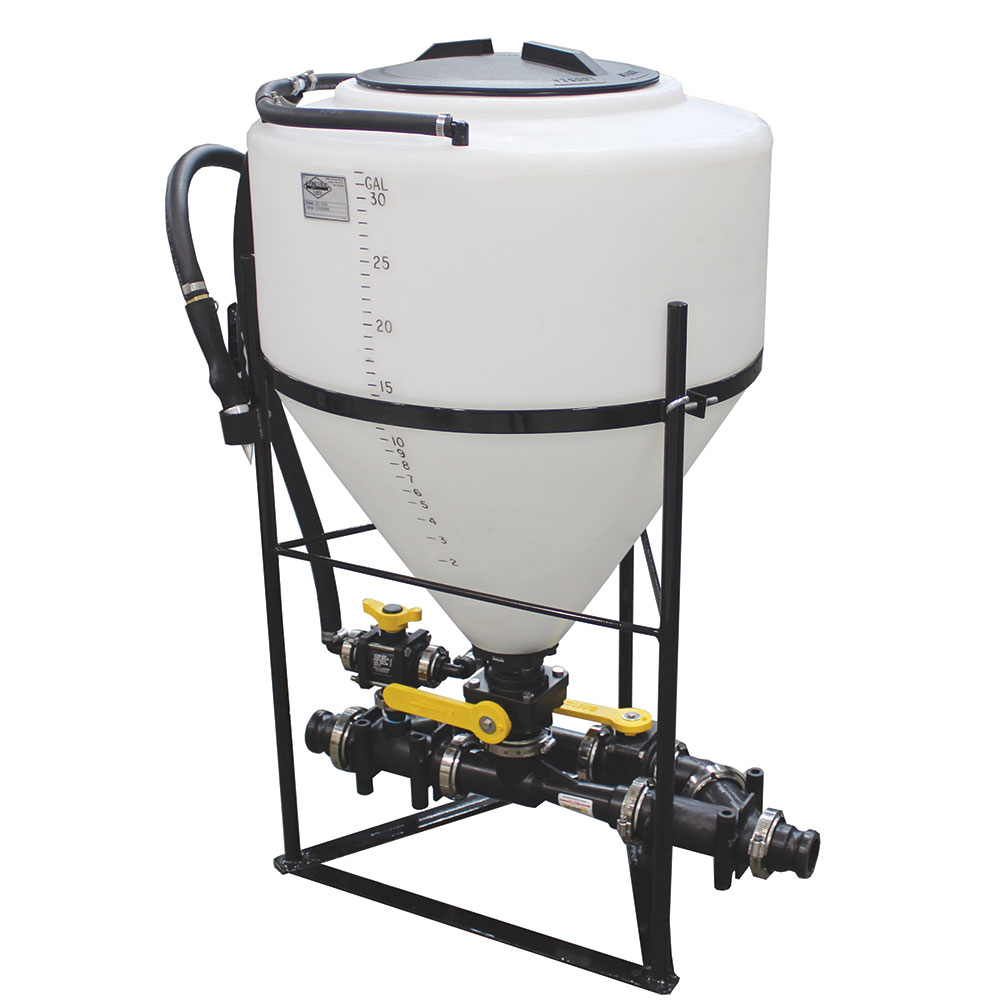
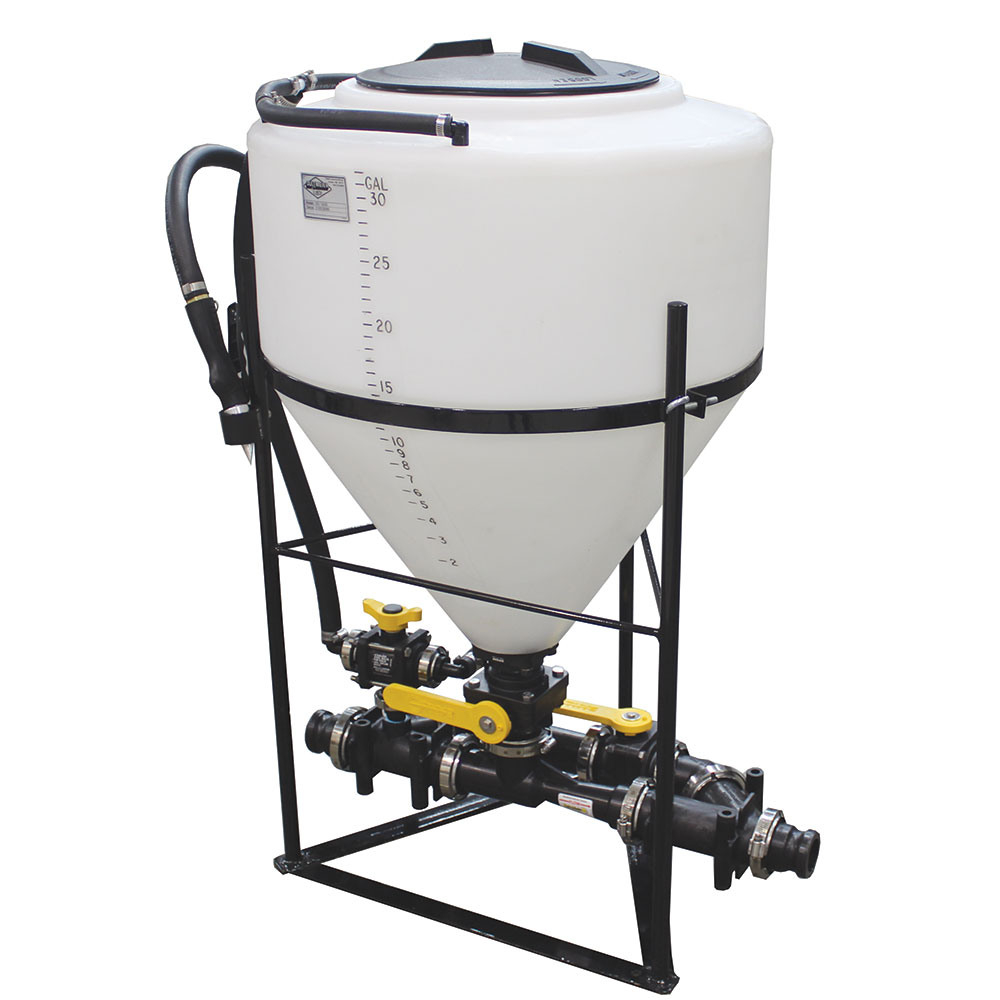
DU1A30 Chemical Inductor System:


Typically, the venuri is connected directly to the outlet of the tank, as with our inductor systems, but when using multiple tanks, you will construct a simple manifold to unite each tank into one inductor assembly. 

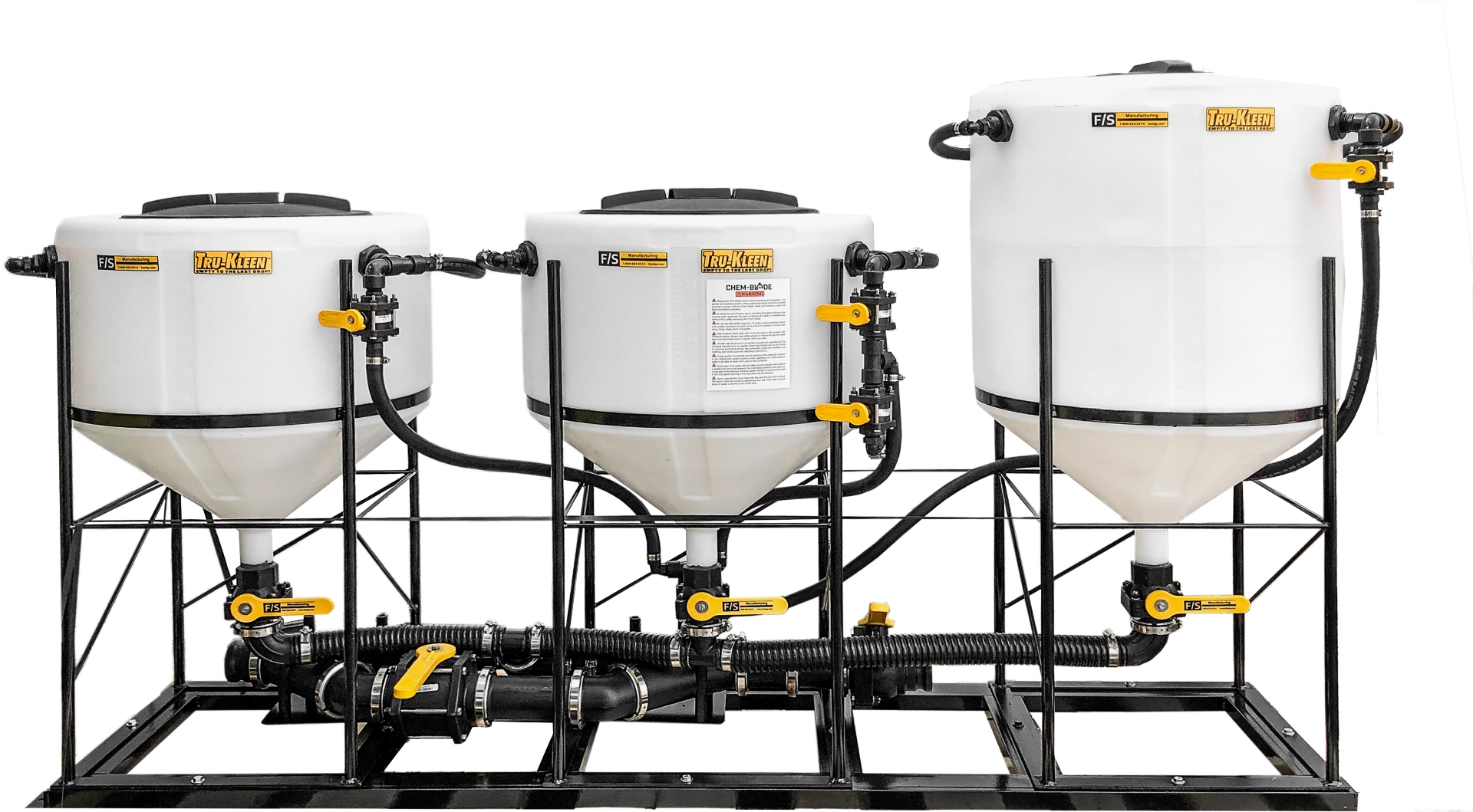
FS Manufacturing builds chemical inductor units with either two or three tanks that share a single inductor assembly. These systems come completely assembled on a skid and have several features for rinsing the tanks and chemical jugs.


FS Tru-Kleen™ Triple Chemical Inductors:


You can check out these options here:


Benefits of FS Tru-Kleen Chemical Inductors:

  • Quality components: Kanaflex hose, Banjo Valves, and fittings
  • Space-saving design: fits into a tight footprint while maintaining easy access to all valves
  • Pre-plumbed and ready for operation: saves you time and headaches
  • Complete drainout tanks: effective and complete cleanout minimizes cross-contamination


Plumbing Multiple Inductor Tanks Together Yourself

With several options, one of the FS Tru-Kleen systems can suit just about anyone. If, however, you have a cone bottom tank or tanks already, then you can join them easily with some specific plumbing components although they won’t have the same streamlined skid and all the rinse options pre-plumbed. 


Here’s what you’ll need:

  • Inductor manifold assembly - Item # TKMIS220A for 2” and TKMIS300A for 3”
  • Cone bottom tanks – Many sizes to choose from, typically one to three, ranging from 30 to 60 gallons
  • 2-inch valve for each tank - TKMVSMT220FP 
  • 2-Inch elbow - TK918-2
  • 2 inch manifold flange x hose barb “tee” - TKM220200HBT x 2
  • 2-inch suction hose - KA390SD-2 (approximately 6-8 ft)
  • Manifold Flange Clamps - TKFC220
  • Manifold Flange Gaskets - TKM221G
  • Rinse hose - GA3204-1425
  • Tank rinse valves - TKUV075FP
  • Tank bulkhead fitting for rinse -  TKTF075
  • Other elbows, nipples, fittings, and clamps will be necessary depending on your setup


Assembly

When you have determined how many tanks you want to use and what sizes, you can begin by positioning them in place. Consider the overall space you have and how close you want each tank. From there, you can get measurements and determine where you can place all of your plumbing components so they are accessible and will not interfere with other pieces. Laying everything out before making permanent connections can be helpful.

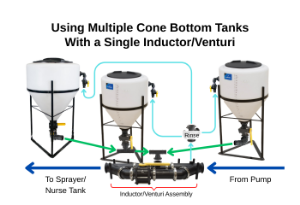
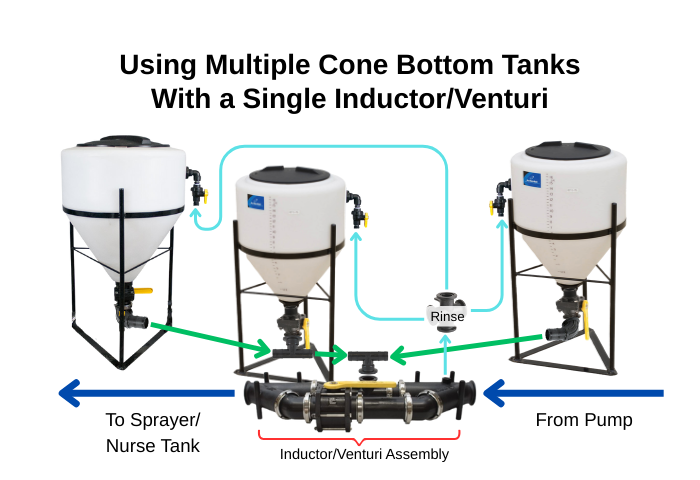
The diagram below can serve as your road map, although you may want different size tanks, spacing, rinse features, etc., the basic layout won’t change. Ultimately, you can set this up in just about any manner you choose as long as the venturi/inductor assembly is still able to draw fluid from each tank at a satisfactory rate. 

The diagram shows basic plumbing to supply rinse water to each tank. You can add multiple rinse ports for a thorough clean-out. You can also use jug rinse nozzles or even a Chem-blade system inside each tank. 


Diagram of Multiple Inductor Tanks

using multiple cone bottom inductor tanks to inject chemical

Important factors to keep in mind during assembly:

  • Ensure the inlet port of the inductor assembly is positioned so the pump is pushing liquid through in the correct direction - see specifics in our inductor guide
  • Make sure all of the valve handles open and close without interference from any tank stand legs, hoses, etc
  • Hoses connecting each tank to the venturi can be curved, but sharp bends or restrictions may affect suction
  • Use quality fittings and secure all connections tightly to prevent air leaks, which can significantly hinder performance
  • Use individual valves on each tank outlet so you can isolate each chemical source


Optional Inductor System Features:

  • Label tanks clearly with product names or batch numbers
  • Consider a check valve upstream of the Venturi to prevent any potential backflow into clean water tanks
  • If pulling thick or slow-dissolving products, recirculate the tank with an eductor or agitation line before pulling through the Venturi
  • Use larger bypass plumbing to fill your sprayer or nurse tank faster when not injecting chemical


Conclusion

Using one Venturi manifold with multiple cone bottom tanks is a smart way to improve efficiency, reduce mixing times, and increase flexibility in your chemical loading process. Whether you're building a custom system with existing tanks or investing in a pre-plumbed unit like the FS Tru-Kleen™ series, the result is a cleaner, faster, and more organized workflow.

Need help designing your setup or picking the right parts? Reach out—we’d be glad to help you find the pieces you need.


Shane Blomendahl, Author

Tech Ag & Industrial Sales

Shane Blomendahl is a tech sales veteran at Dultmeier Sales with over 10+ years of experience in liquid handling products covering several industries and applications.

Learn More About the Author

Liquid Fertilizer Storage Tank Guide
(0) Liquid Fertilizer Storage Tank Guide

Fertilizer leaking out of a storage tank is not just a safety hazard; it is also an expensive problem. This makes selecting a fertilizer storage tank so important, whether you’re a fertilizer dealer handling bulk storage or a farmer looking for on-farm solutions, the right material, size, and shape count.

For decades, Dultmeier Sales has been helping fertilizer retailers and farmers with fertilizer storage, and this has gained us valuable insights. In this post, we’ll use this knowledge to cover the different types of liquid fertilizer storage tanks—polyethylene, fiberglass, steel, and stainless steel—and the pros and cons of each. We’ll also go over the different sizes and shapes, examining which ones work best for what.

Selecting a Liquid Fertilizer Storage Tank

No matter what type of fertilizer, there are two crucial things to consider up front. First is the compatibility of the fertilizer with the tank material. The second is the weight of the fertilizer. 

1. Compatibility of Fertilizer with Tank Material

Different fertilizers have varying properties that can interact differently with different tank materials. For instance, some micronutrient formulations can have pH levels (extremely low or high), which may not be compatible with certain tank materials

See also: Chemical Compatibility Charts

2. Weight of the Fertilizer

Liquid fertilizers are denser than water, and their weight can vary depending on their composition. For example, Urea Ammonium Nitrate (UAN) solutions can have densities up to around 11 pounds per gallon. It’s crucial to ensure that the selected tank can support the weight of the fertilizer, especially when dealing with large volumes. 

By carefully considering both the chemical compatibility and the weight of the fertilizer, you can select a storage tank that ensures safety and longevity in your fertilizer storage solutions.

Other Factors to Consider

Beyond fertilizer compatibility and weight, there are several other key factors to consider when selecting a liquid fertilizer storage tank:

  • Tank Location & Installation: Ensure that tank outlets and tie-downs are not interfering with other tanks, pipes, etc.
  • Venting & Pressure Management: Proper venting aids filling and unloading
  • Mixing & Agitation: Suspension fertilizers may settle, requiring built-in agitation
  • Filling & Dispensing: Ensure easy loading/unloading for nurse trailers or sprayers.
  • Regulatory Compliance: Ensure you are aware of all guidelines for your region.
  • Future Expansion: Tank layout and location should make any expansion simple to add (if possible). 

Best Storage Tank Options for Liquid Fertilizer

Tank material is the primary attribute that separates different tank options. Material affects the lifespan, cost, compatibility, repairability, installation, temperature rating, and more. 

Steel Tanks

Steel tanks are often used to store large quantities of fertilizer. They are typically made to order and typically used to store large volumes, 30,000 gallons or more. Their durability makes them a reliable choice, however, there are some drawbacks. Here are the keys to consider:

Advantages of Steel Tanks for Fertilizer

  • Durability & Strength – Steel tanks are highly durable and can withstand physical impacts better than plastic or fiberglass.
  • Long Lifespan – With proper maintenance, steel tanks can last 20+ years, making them a solid long-term investment.
  • Fire Resistance - Steel does not melt and is not going to warp under higher temps.
  • High Capacity Options – Steel tanks can be custom-built in large sizes (30,000+ gallons), making them ideal for bulk fertilizer storage.
  • Repairable - Steel can be welded, patched, and painted as needed. 
  • Resale Value – Steel tanks hold some resale value and can be scrapped or repurposed if no longer needed.

Disadvantages of Steel Tanks for Fertilizer

  • Corrosion Risk – Steel is prone to rust and corrosion, especially with certain fertilizers (UAN solutions, ammonium nitrate). Requires protective coatings or linings to prevent deterioration.
  • Higher Cost – Initial purchase and installation costs are typically higher compared to polyethylene or fiberglass tanks.
  • Upkeep – Welded seams and fittings can develop leaks over time, requiring maintenance and inspection.
  • Compatibility – Some highly corrosive fertilizers may still degrade lined steel tanks over time.
  • Lead time - Steel tanks are typically made to order and not readily available due to the potential custom nature of each order.

Steel tanks can be equipped with several fittings and features at the factory, including sight gauges, vents, manways, lift lugs, fill/outlet fittings, etc. Contact us to get a quote and shipping estimate on steel storage tanks. 

Steel Tanks Manufactured by:


Fiberglass Tanks

Storing fertilizer in fiberglass tanks is a very practical choice. They are available in sizes ranging from about 8000 gallons up to 30,000 gallons. Typically, these tanks have a 12 ft diameter (other sizes are available) and a height ranging from 10 - 35 ft. 

Advantages of Fiberglass Tanks for Fertilizer

  • Corrosion Resistance - Excellent resistance to corrosion, suitable for a wide range of chemicals. Special resins available to handle certain chemicals and fertilizers.
  • Lightweight - Easier to handle and install compared to steel tanks.
  • Lifespan – Can last longer than steel if properly maintained. UV coatings can be reapplied to increase lifespan. 
  • Durability - Long lifespan with proper maintenance.

Disadvantages of Fiberglass for Fertilizer

  • Cost - Generally more expensive than polyethylene tanks.
  • Susceptibility to Damage - Can be prone to impact damage if not handled carefully. Prone to puncture or cracks if impacted by equipment.
  • Difficult to Repair - Fixing damage will require specialized training
  • Availability - Like steel, tanks are custom-made to order and not readily available

Fiberglass tanks are also made to your specs at the factory, ensuring they fit your location and can handle the liquid to be stored. Available options include: sight gauges, lift lugs, vents, manways, flanged outlets, re-circulation packages, etc. Call us for a quote on a fiberglass fertilizer storage tank. 

Fiberglass Tanks Manufactured by:


Polyethylene Tanks

Polyethylene or “poly” tanks are a versatile option for fertilizer storage. They come in the widest range of sizes and shapes to suit a wide range of needs. Typically used for sprayer, nurse trailers, tender trailers, and cone bottom inductor tanks, poly tanks are also used for bulk liquid fertilizer storage.


Polyethylene has excellent compatibility with a wide variety of fertilizers, and although they are not as durable as steel or stainless, they can be made to store heavy liquids (14lbs/gal or more if needed) such as 10-34-0. Be sure to confirm that a tank has a Specific Gravity rating that will handle the fertilizer you want to house. 

Advantages of Poly Tanks with Fertilizer

  • Corrosion Resistance - Highly resistant to a variety of chemicals, making them suitable for storing fertilizers.
  • Lightweight - Easier to transport and install due to their reduced weight.
  • Cost-Effective - Generally more affordable compared to other materials.
  • Availability - Poly tanks are made in standard sizes and can be found in stock. (Dultmeier keeps several tank sizes in stock; we can get tanks that are not in stock, typically in 4-12 weeks, depending on the tank)

Disadvantages of Poly Tanks with Fertilizer

  • Temperature Sensitivity - Can become brittle in extremely cold temperatures and may deform under high heat.
  • Limited Lifespan - They typically have a shorter lifespan compared to steel or fiberglass tanks.
  • Limited Size - The manufacturing process of poly tanks is limited in size; typically, 20,000 gallons is the largest poly tank that is available. 

At Dultmeier Sales, we offer a variety of polyethylene tanks suitable for fertilizer storage supplied from Ace Roto Mold, Snyder, and Norwesco. Poly tanks can be custom built but typically, the tanks are made in standard configurations and are more readily available. 

You can contact us to find the available poly tank options that are able to store fertilizers.


Stainless Steel 

A stainless tank is hard to beat for liquid fertilizer storage, compatibility, strength, and lifespan are really unmatched by other tanks, however, this comes at a cost. Here are the pros and cons of stainless steel tanks for fertilizer storage:

Advantages of Stainless Steel Tanks for Fertilizer Storage

  • Durability: Highly durable and resistant to corrosion, ideal for long-term storage.
  • Strength: Can withstand high pressures and extreme temperatures.
  • Hygiene: Easy to clean and does not support bacterial growth.

Disadvantages of Stainless Steel Tanks for Fertilizer Storage

  • Cost: Significantly more expensive than other materials.
  • Weight: Heavier, which can increase transportation and installation costs.

We supply stainless steel tanks manufactured by Precision Tank and Meridian Mfg. Whether you need a nurse tank, weight tank, or cone bottom storage tank, we can provide you a quote with the appropriate accessories to fit your truck, trailer, or building site.   


Tank Size

Liquid fertilizer storage tanks are available in a range of sizes, typically from 1,000 to 30,000 gallons and beyond. The appropriate size depends on your storage requirements and application. 

Tank Material Common Sizes (Gallons)
PolyUp to 15,000
Fiberglass8400 - 30,000
Steel10,000-30,000
Stainless Steel1700-6100

Tank Shape

Flat Bottom Tanks

Advantages

  • Cost-Effective: Generally less expensive due to simpler design.
  • Ease of Installation: Can be placed on various surfaces like concrete or gravel.

Disadvantages

  • Incomplete Drainage: May retain some liquid at the bottom, which can be problematic for certain applications.

Cone Bottom Tanks 

Advantages:

  • Complete Drainage: Allows for total evacuation of contents, reducing residue.
  • Ideal for Mixing: Beneficial when the complete drainage of mixed solutions is necessary.

Disadvantages:

  • Additional Equipment: Requires a stand and possibly a more complex installation.
  • Higher Cost: Generally more expensive due to design and additional components.

Horizontal Tanks

Advantages:

  • Stability: Lower center of gravity provides stability during transport.
  • Space Efficiency: Can be mounted on trailers or trucks for mobility.

Disadvantages:

  • Limited Capacity: Typically smaller in size compared to vertical tanks.


Best Fertilizer Tanks for Various Applications

Fertilizer Dealer/Terminal Storage:

  • Recommended Materials: Stainless steel or fiberglass for durability and corrosion resistance.
  • Tank Shapes: Flat-bottom tanks for large-volume storage; cone-bottom tanks if complete drainage is necessary.
  • Sizes: Larger tanks, ranging from 10,000 to 30,000 gallons

Bulk Storage on Farms:

  • Recommended Materials: Polyethylene for cost-effectiveness and versatility; fiberglass for enhanced durability.
  • Tank Shapes: Flat bottom tanks for stationary storage; Cone bottom tanks for mixing and complete cleanout.
  • Sizes: Typically between 1,000 to 5,000 gallons, based on farm size and usage. Larger sizes available.

Nurse Trailers:

  • Recommended Materials: Polyethylene due to its lightweight nature. Stainless for easy clean out and durability
  • Tank Shapes: Horizontal tanks and elliptical leg tanks

Sizes: Generally 1,000 to 4250 gallons


Making the Right Choice

Dultmeier Sales can help you to find the best tank for your operation. Simply provide the necessary details about the liquid you want to store and we can help you through the process. Call us today for more information!


Shane Blomendahl, Author

Tech Ag & Industrial Sales

Shane Blomendahl is a tech sales veteran at Dultmeier Sales with over 10+ years of experience in liquid handling products covering several industries and applications.

Learn More About the Author

TeeJet Spray Nozzle Selection Guide
(0) TeeJet Spray Nozzle Selection Guide

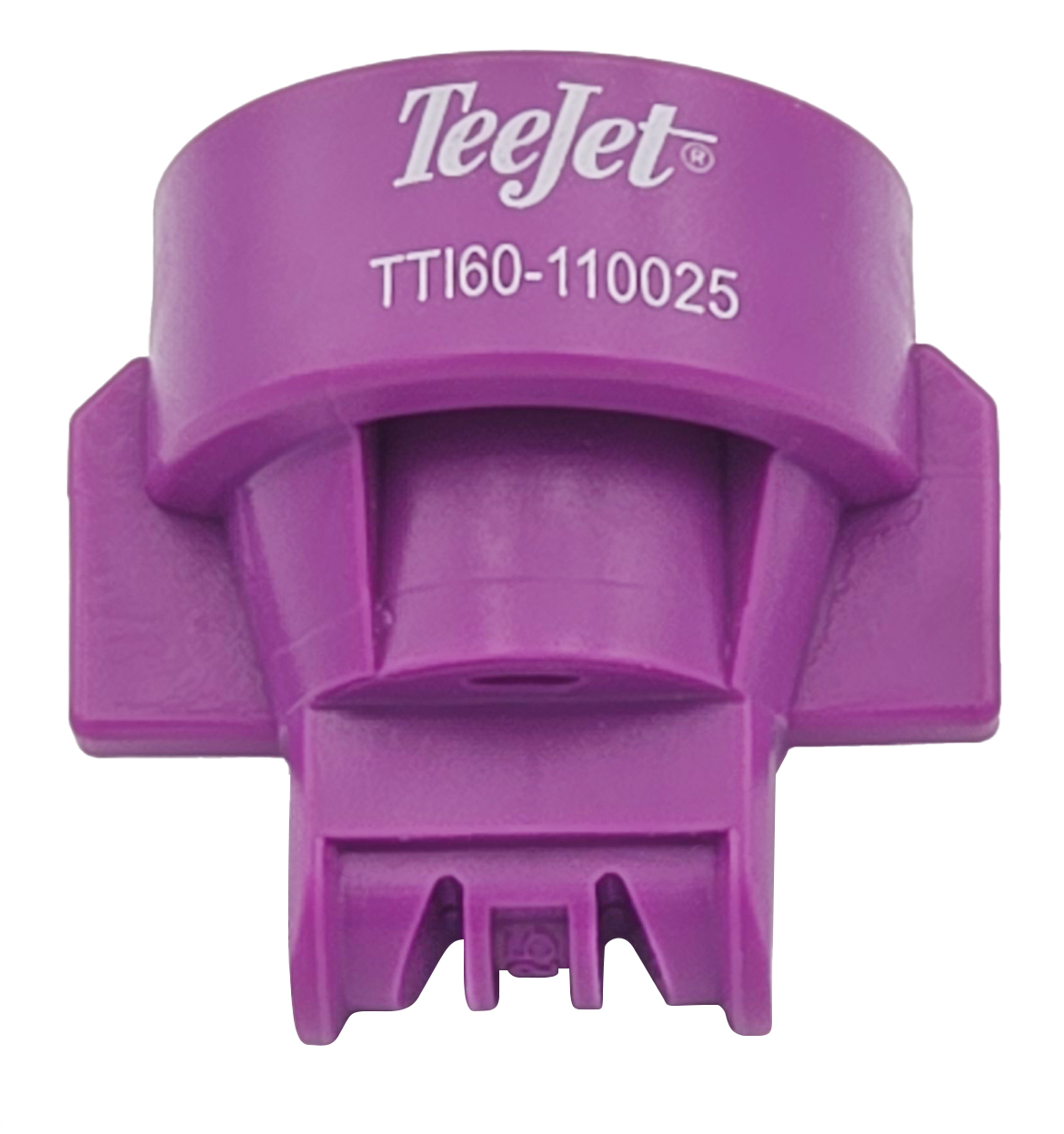
Sprayer nozzles are the heart of precision application, driving a global market projected to hit $4.15 billion by 2034, with agriculture accounting for a significant share of that demand. TeeJet is at the forefront with innovative nozzles to maximize coverage and reduce drift.

Here at Dultmeier Sales, we want to provide the latest Teejet nozzle offerings to meet the changing needs of our customers. We strive to accomplish this by keeping a wide selection in stock and offering expert help in selecting the best nozzle for your application.


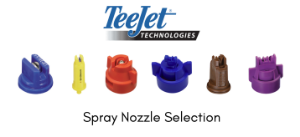
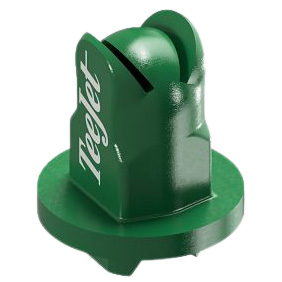
different Teejet spray nozzle options


In this guide, we will examine the various TeeJet spray nozzles. We will look at the unique attributes of each type, explaining the differences, and also show you which applications each nozzle is best suited to handle.

RELATED: Check out our nozzle selection tool to find out which TeeJet nozzle will fit your application.


Explaining the TeeJet Spray Nozzles Options

With so many different options, selecting a Teejet nozzle is a bit overwhelming. After all, on the surface, they all seem so similar, but the pattern and droplet size they produce make a huge difference.

Let’s look at the most popular TeeJet nozzles for boom sprayers and boil down all the technical design features into the bottom line for each type,e and when you should use them.

It should be noted that we will discuss droplet size quite often in this guide. If you want a quick explanation, be sure to read this article on spray nozzle droplet size and how it is classified.


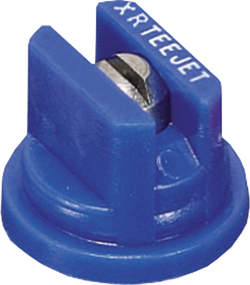
TeeJet® Extended Range Spray Tips - XR & XRC


The XR TeeJet® nozzle is the go-to solution for growers who want fine droplets and spray at lower speeds (approx 8 mph or lower). These tips offer great coverage at low pressure (15-30 PSI range) where drift is minimized.

While the coverage is excellent, the drift potential does increase as you speed up and increase pressure. For self-propelled sprayers and higher speeds, see the air-inducted nozzle options below.

Key Specifications

  • Spray Pattern: Wide-angle flat fan
  • Spray Angle: 110°
  • Droplet Size: Fine (F) to Medium (M)
  • Pressure Range: 15–60 PSI
  • Material Options: Polymer (VP) or Ceramic (VK)

Recommended Applications

  • Best for applications requiring thorough coverage but with low drift concern
  • Best for spraying at lower speeds (less than 10mph)

We have the XR tip only and the full XRC nozzle assembly in stock.


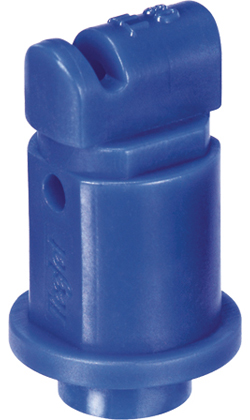
Turbo TeeJet® Spray Tip - TT

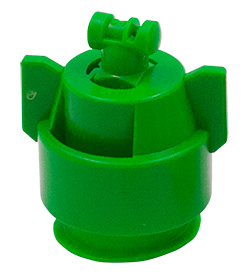
The Turbo TeeJet® (TT) nozzle is a long-time workhorse known for its versatility and fine spray coverage. Farmers appreciate its uniform spray coverage and resistance to clogging, making it an ideal all-purpose choice for broadcast applications. The 15° downward angle enhances canopy penetration, while the large internal passage minimizes plugging, reducing downtime in the field.

The droplet sizes produced by the Turbo TeeJet are finer than most other nozzle types. Producing only a slightly larger range of droplets than the XR series, this means excellent coverage but potential drift concerns, especially at higher pressures or when spraying at higher speeds.

Key Specifications

  • Spray Pattern: Wide-angle flat fan
  • Spray Angle: 110 Degree
  • Droplet Size: Medium (M) to Coarse (C)
  • Pressure Range: 15–90 PSI
  • Material Options: Polymer (VP) or Ceramic (VK)

Recommended Applications

  • Suitable for PWM
  • Applications needing fine droplets but have little drift concern, such as insecticides and fungicides.

Available as TT Tip only or full Turbo TeeJet Nozzle/Cap Assembly


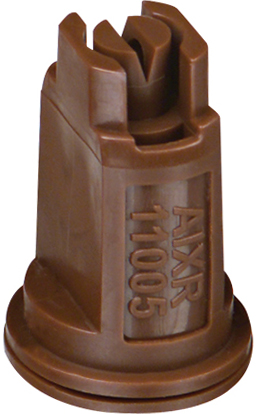
Air Induction Extended Range Spray - AIXR


The AIXR TeeJet® nozzle is a favorite for balancing drift control and coverage quality. Using Venturi air-induction technology, it produces larger droplets than the XR/XRC and TT nozzles. Reducing drift while maintaining effective herbicide contact across a greater range of speeds and pressures.

Key Specifications

  • Spray Pattern: Wide-angle flat fan
  • Spray Angle: 110°
  • Droplet Size: Coarse (C) to Extremely Coarse (XC)
  • Pressure Range: 15–90 PSI
  • Material Options: Polymer (VP) or Ceramic (VK)

Recommended Applications

  • A better option if you like the XR tip but want to travel at higher speeds

Available as tip only or full tip/cap/gasket assembly.


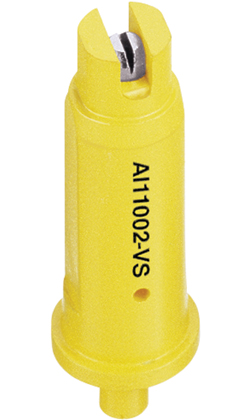
AI TeeJet® Air Induction Spray Tip


The AI TeeJet® nozzle is built for drift-sensitive applications. It produces a range of coarser droplets than the XR, TT, and even the AIXR. This significantly minimizes drift while still providing consistent coverage.

Despite the larger droplet size, the coverage is still good because the droplets offer good penetration and explode into smaller droplets when they impact the ground or plant surface. This nozzle is an excellent choice for self-propelled sprayers. While the XR and TT nozzles offer great coverage at low speed, they are more easily blown off target at higher speeds, so despite the larger droplets of the AI TeeJet, the coverage is still better because more droplets reach the intended target.

Key Specifications

  • Spray Pattern: Wide-angle flat fan
  • Spray Angle: 110° or 80°
  • Droplet Size: Very Coarse (VC) to Ultra Coarse (UC)
  • Pressure Range: 30–115 PSI
  • Material Options: Stainless Steel, Polymer Insert

Recommended Applications

  • Use in applications when you need drift control but want to maintain effective coverage on plant surfaces as well as canopy penetration

Available as tip only or as a complete one-piece tip/cap/gasket.


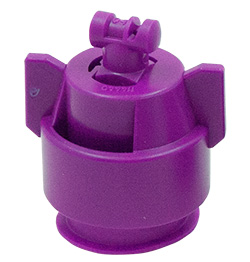
Turbo TeeJet Induction® Spray Tip TTI


The Turbo TeeJet Induction® tip offers the largest droplet size range from a flat fan TeeJet nozzle. Offering ultra-coarse droplet sizes at a wide range of operating pressures, it is suited for applications requiring the highest level of drift reduction.

This nozzle is approved for Monsanto XtendiMax, DuPont FeXapan 20-63 PSI, BASF Engenia, Enlist DUO, and Enlist One max*.

Key Specifications

  • Spray Pattern: Wide-angle flat fan
  • Spray Angle: 110°
  • Droplet Size: Ultra Coarse (UC)
  • Pressure Range: 15–100 PSI
  • Material Options: Polymer (VP) or Ceramic (VK)
  • Cap Compatibility: Quick TeeJet® Cap System

Recommended Applications

  • Use TTI for applications requiring the highest level of drift control but still need a flat fan nozzle.
  • This tip is currently approved for Monsanto XtendiMax, DuPont FeXapan 20-63 PSI, BASF Engenia, Enlist DUO, and Enlist One max.

Available as tip only or as a complete one-piece tip/cap/gasket.


Turbo TwinJet® Spray Tip TTJ60

The Turbo TwinJet® nozzle is designed for maximum leaf coverage, featuring two spray fans angled 60° apart for multi-directional coverage. When coverage is critical, the twin pattern improves canopy penetration, ensuring spray reaches both sides of leaves and dense foliage.

Producing medium to coarse-size droplets, the Turbo TwinJet is a nozzle that is hard to beat when it comes to thoroughly covering plant surfaces. It is best suited for lower-speed sprayers; for self-propelled sprayers traveling at higher speeds, look to the air-inducted twin fan nozzles below.

*One key to note is that the volume per minute flow produced by a dual fan nozzle is the same as a single fan nozzle of the same color. In dual fan nozzles, the flow is evenly distributed between each fan.

Key Specifications

  • Spray Pattern: Twin flat fan
  • Spray Angle: 110°
  • Droplet Size: Medium (M) to Coarse (C)
  • Pressure Range: 20–90 PSI
  • Material Options: Polymer (VP)

Recommended Applications

  • Similar to the standard TT but with the added benefit of more thorough canopy penetration.

Available as a tip only or as a complete one-piece tip/cap/gasket.


AI Turbo TwinJet® Spray Tip - AITTJ60

Turbo TwinJet Spray Tips


The AITTJ60 combines air induction drift reduction with a dual spray pattern for optimal coverage and canopy penetration. The air-induction design creates larger droplets that are more drift-resistant, while the dual spray fans enhance leaf coverage from multiple angles. Simply put, because of the dual fan this nozzle is better suited for post-emergence applications than other single flat fan nozzles that produce similar droplet size ranges.

Key Specifications

  • Spray Pattern: Twin flat fan
  • Spray Angle: 110°
  • Droplet Size: Coarse (C) to Ultra Coarse (UC)
  • Pressure Range: 20-90 PSI
  • Material Options: Polymer (VP)

Recommended Applications

  • Post-emerge applications when you need to penetrate a dense canopy and need moderate drift reduction when traveling at higher speeds, roughly 9-10 mph or more. Increased spray speed is basically adding more “wind” speed and wind can drastically increase drift.

Find Your Size: The AITTJ60 is available as a tip only or a complete tip/cap/gasket assembly.


TTI TwinJet® Spray Tip – Maximum Drift Control with Twin Pattern Coverage


The TTI TwinJet® nozzle combines the ultra-coarse drift-reducing droplets of the TTI with the superior coverage of a twin fan spray pattern. This nozzle provides the droplet size required for Dicamba applications, including Engenia® and XtendiMax® Herbicides.

Key Specifications

  • Spray Pattern: Twin flat fan
  • Spray Angle: 110°
  • Droplet Size: Ultra Coarse (UC)
  • Pressure Range: 20–100 PSI
  • Material Options: Polymer (VP)

Recommended Applications

  • Systemic Herbicides (Dicamba, 2,4-D)
  • Extremely Drift-Sensitive Applications
  • If you need the drift reduction offered by the TTI nozzle but want more canopy penetration and leaf coverage, the TTI TwinJet® is ideal.

You can find your TTI TwinJet® nozzle size here.


AccuPulse® TwinJet® Spray Tip - APTJ


The AccuPulse® TwinJet® nozzle is specifically engineered for PWM sprayers. This innovative nozzle offers extremely Coarse (XC) to ultra Coarse (UC) droplets without the use of air induction. Its design ensures consistent flow, even under variable application rates associated with PWM setups, but the nozzle can also be used with non-PWM systems.

The twin spray fans improve canopy coverage, making it an excellent choice for a very wide range of both pre- and post-applications.

Key Specifications

  • Spray Pattern: Twin flat fan
  • Spray Angle: 110°
  • Droplet Size: Extremely Coarse (XC) to Ultra Coarse (UC)
  • Pressure Range: 20–100 PSI
  • Material Options: Polymer (VP)
  • Designed for: Pulse Width Modulation (PWM) sprayers

Recommended Applications

  • PWM Spraying Systems
  • Applications where you need as much drift reduction as possible from a flat fan nozzle.

Find your AccuPulse Nozzle here!


Have Questions?

If you need any assistance selecting a nozzle, please give us a call. While we can tell you what nozzle to use, we can tell you what TeeJet nozzle will provide you with the droplet size and coverage that best suits your application requirements.


Nozzle Resources


*Nozzles approved for various herbicides is subject to change based on government guidelines/regulations.


Shane Blomendahl, Author

Tech Ag & Industrial Sales

Shane Blomendahl is a tech sales veteran at Dultmeier Sales with over 10+ years of experience in liquid handling products covering several industries and applications.

Learn More About the Author

Sprayer Tender Trailer Setup Guide
(0) Sprayer Tender Trailer Setup Guide

Reducing loading time is possible with the right sprayer tender trailer setup. Every aspect of your system can affect your efficiency. From the transfer pump, chemical inductor, mixing systems, and even your hoses and fittings. At Dultmeier Sales, we have been helping to set up tender trailers for decades and today we will discuss how to select these items to create the ultimate tender trailer for your operation. 


Main Components of a Sprayer Tender Trailer

Whether it is a truck, flatbed, or bumper hitch trailer, the basic components used on a sprayer trailer consist of the following (click on each item to jump to that section in this article):

While the primary components are similar they are not all created equal. Each component comes with a range of options, making it essential to evaluate their features carefully. Let’s take a closer look at each component, explore their key attributes, and discuss how they can affect the overall function of your setup.


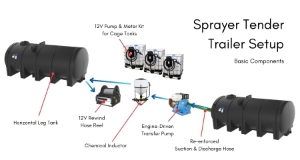
Sprayer Tender Trailer Plumbing Diagram
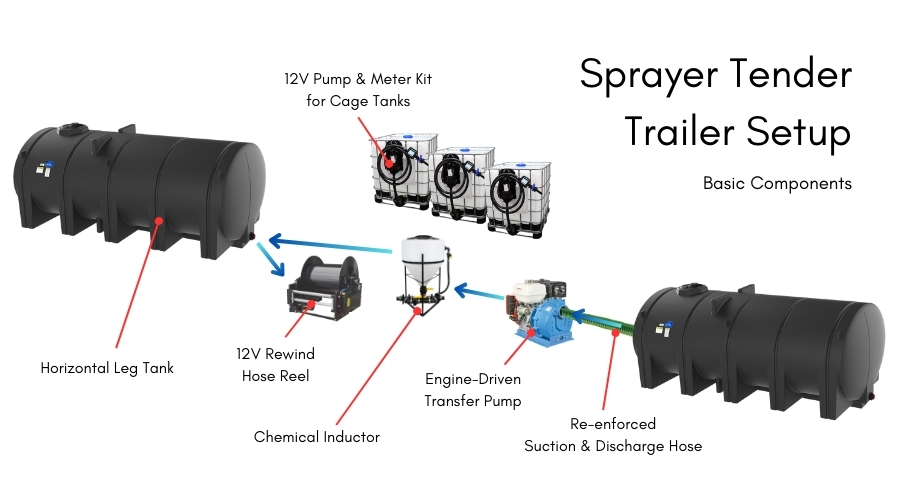
Sprayer tender trailer diagram


Tanks for Sprayer Trailer

The first individual component we should cover is the tanks. After all, without them, a nurse trailer is pretty useless. The job of your tank is simple, but there are several aspects to consider. Tank design can have a rather large impact on the function and efficiency of your setup so it is worth your time to consider these as you select your tank.
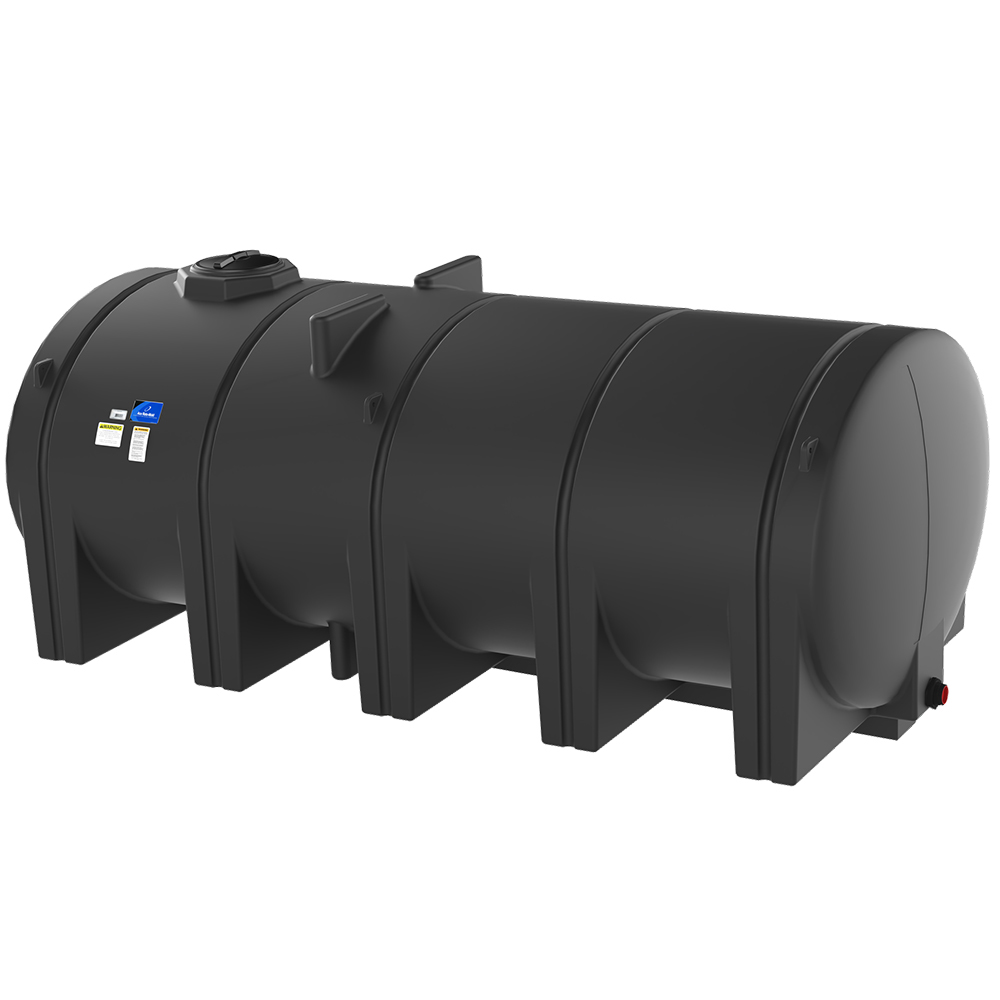
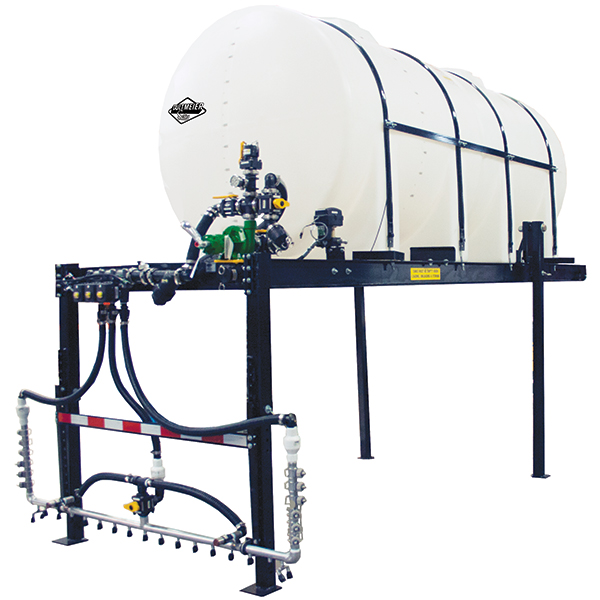
Horizontal Leg Tank


Size & Shape

Tank size is the primary consideration. You will need to consider what your trailer or truck can handle as well as the volume of water you will need on a daily basis. The amount of water you need depends on several factors that will be unique to your situation. 

For example, if you need 1,000 gallons of water to spray 80 acres, you can calculate the total water needed by how many total acres you expect to spray in a day or how many acres you need to spray before refilling. To spray 240 acres without having to return the tender trailer to refill, you would need a tank that holds at least 3,000 gallons of fresh water.

Horizontal leg tanks are designed to fit on flatbed trailers and trucks. These are ideal for nurse trailers because they are low-profile, and contain baffling both of which make them safer for over the road than other tank styles. They come in sizes ranging from around 1,000 gallons up to nearly 5,000 so there are plenty of options.

The keys to consider are how the tank drains and the outlet size. There are flat bottom versions and tanks with a sump to provide a more complete drain out. The more complete drainout is an advantage over flat bottom tanks however they typically require a skid which makes them more expensive. 

When you are looking for tanks you can always look at the tank drawing that shows the slope, outlet sizes, and other tank dimensions. This way you can ensure it fits your trailer and has the features you want. Contact us if you need help accessing the drawings for a specific tank. 

Tank Material

Most sprayer tender tanks are made of polyethylene, a durable, lightweight, and chemical-resistant material. The strength of these tanks is primarily determined by their Specific Gravity (SG) rating, which indicates the tank's ability to hold liquids of varying densities.

At Dultmeier Sales we carry Ace Roto Mold, Snyder, and Norwesco poly tanks. These tanks are typically all rated to handle liquids weighing up to 14 lb per gallon. This will cover most fertilizers and obviously water which is much lighter. We also can get heavy-duty tanks which are rated for much heavier liquids if necessary.

Stainless Steel Tanks are more expensive but highly durable, easy to clean, less risk of cross-contamination. Resistant to UV degradation, punctures, and chemical wear, stainless steel tanks often last decades with proper maintenance.

Algae Prevention

One of the major concerns people have with their nurse trailer tanks is the growth of algae inside the tank. To prevent this you must eliminate any sunlight from getting into the tank. While poly tanks do have UV inhibitors, a black-colored tank is the only way to eliminate all sunlight. It is important to note, however, that you cannot see the liquid level in a black tank. So if you install a clear site gauge tube, sunlight will enter through this clear tube and algae may grow.


Tender Trailer Pump Selection

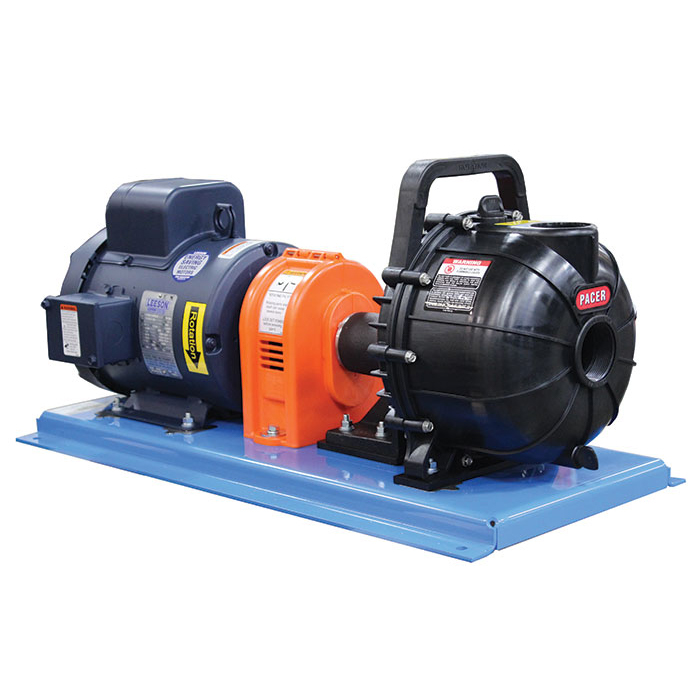
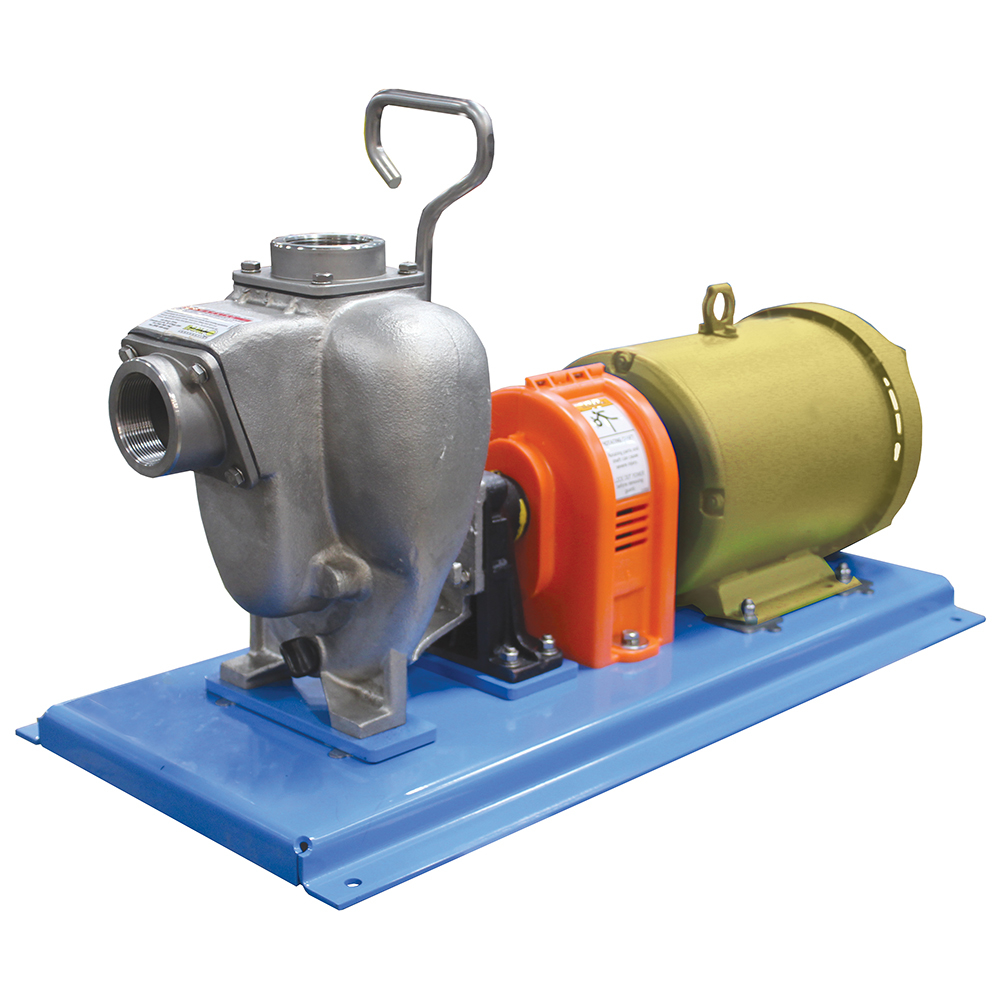
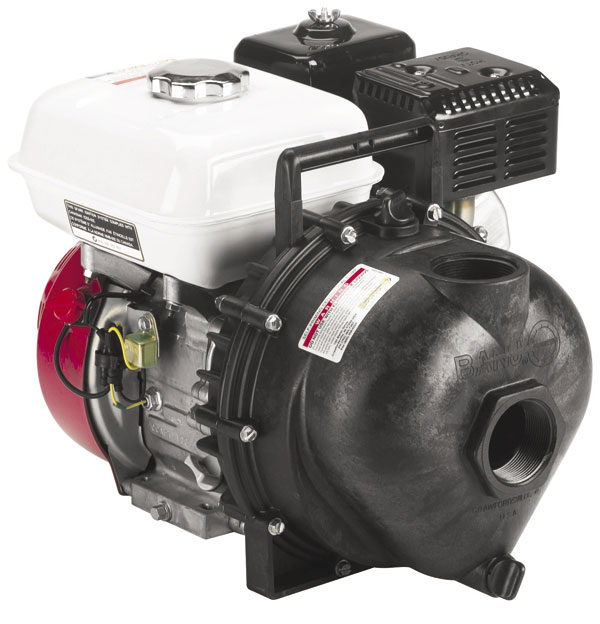
Typically, a sprayer trailer will feature at least one centrifugal transfer pump. A centrifugal pump is king when it comes to moving high volumes of liquid. When it comes to agricultural tender setups, two and three-inch engine-driven pumps offer the perfect combination of flow rate, affordability, and flexibility. 

Polypropylene body pumps work well, they don’t rust and are compatible with several chemicals/fertilizers. A poly pump will be the less expensive but if you desire something that is more durable, cast-iron pumps are a great option. They are subject to rust, but they don’t break or crack as easily from the stress put on the pump. Think about the weight of your hoses or handling the hose when you move it around to fill your sprayer.
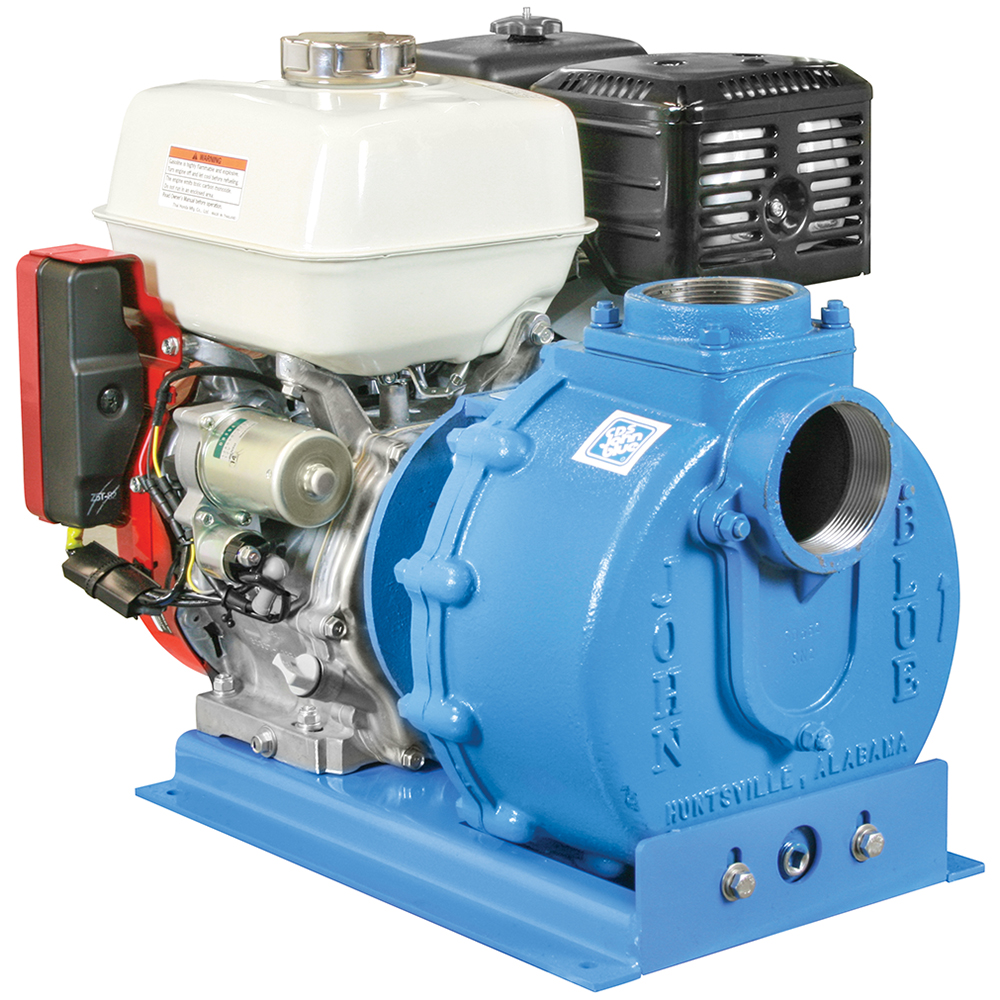
 

John Blue 3-Inch Pump with Honda Engine


Pump Features That Make Your Setup More Convenient

In addition to the material, there are other important pump features that will make your life a lot easier. First, an electric start gas engine lets you start the pump by turning a key/switch. These cost more but they will save your shoulder if you are starting your pump multiple times a day.

A wet seal or lubricated seal on a pump will protect the mechanical shaft seal if the pump is run dry, meaning it is operated with no liquid in it. Running a pump dry can lead to cavitation. This will damage the seal and result in a leak. It does not take long for this damage to occur. Pumps with wet seals keep things cool when the pump has no fluid passing through it. This way, if you empty a tank and do not shut the pump off right away, the pump will be safe from damage.

Manifold flanges are a style of connection instead of national pipe thread manifold flanges are held together, clamp and gasket, and are much easier to make changes to your setup or replace and isolate parts that you may need to replace. For more information see our Banjo Manifold flange guide.  

Pump Flow Rate

One of the most important aspects of your pump is obviously the flow rate. When selecting the pump for your trailer you should look for a pump that is capable of delivering adequate flow but remember a centrifugal pump does not determine the flow by itself. Ultimately, the flow you can achieve is based on several aspects of the entire plumbing setup. In addition to the pump, the plumbing will determine the maximum flow you can achieve.  This concept is explained in more detail in our centrifugal pump guide

For help selecting a transfer pump, you can take a look at this detailed centrifugal pump selection guide. It focuses on fertilizer pumps, but the information is relevant for water and chemical transfer as well. 


>View All Gas-Engine Pump Unit Options


Tender Trailer Plumbing

The size of your plumbing plays a crucial role in determining how quickly you can mix batches and load your sprayer. The plumbing size refers to the inside diameter (ID) of the fluid path (hose, strainers, pump ports, valves, etc.) For agricultural tender trailers, 2-inch and 3-inch plumbing are common options. 

2-inch typically grants you a maximum flow rate of about 200 GPM while 3-inch plumbing can accommodate roughly 400 GPM. These numbers are estimates and depend on a lot of additional factors such as the pump type, horsepower, liquid, number of elbows, strainers, total length of hose, etc. 

Consistency in Plumbing Size is Key

Maintaining a consistent fluid path throughout the system is key to maximizing your flow rate. This means paying attention to the inside diameter (you're going to get tired of that term but it is important) of all the plumbing components on the trailer. Including but not limited to the pump, hose, valves, fittings, and strainers. 

Let's look at an example to see why this is so crucial. If you use a 2-inch pump, then you will want to use 2-inch hose. So far so good. But if your strainer has only 1.5-inch ports, the strainer becomes a bottleneck, restricting flow. This is true for valves. Even if your valve or strainer has a 2-inch pipe thread the actual fluid path may be smaller. So how do we avoid this? 

Full Port Fittings: Why Inside Diameter Matters

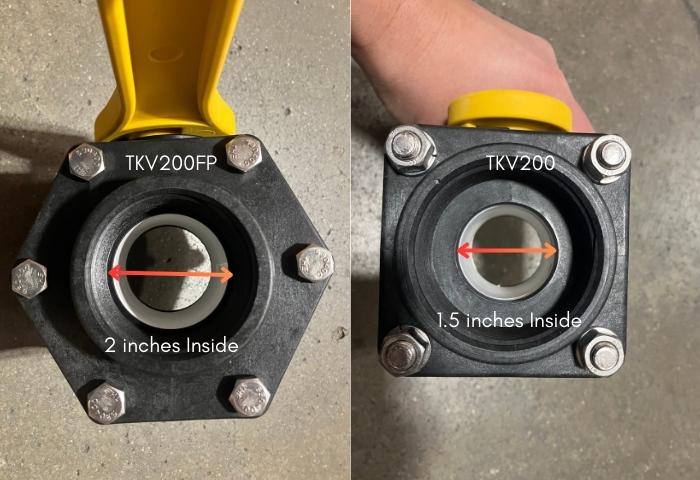
The answer is to be picky when choosing your plumbing components. When choosing valves, fittings, and other components, look for "full port" options. Full port fittings maintain the advertised inside diameter throughout the fluid path. For instance, a standard 2-inch valve might have a 1.5-inch fluid path, whereas a 2-inch full port valve provides the full 2-inch ID, eliminating unnecessary restrictions.

  • Example: TKV200 is a two-inch Banjo valve. It has two-inch female threaded ports but the inside diameter fluid path only measures 1.5 inches. Compare this to another Banjo TKV200FP, another “two-inch” valve, but it has an inside fluid path that measures two inches in diameter:  


Avoid Pump Cavitation with Proper Sizing

Maintaining a consistent port size throughout is not just about flow rate. It is also critical to keep your fluid path on the suction side of the pump at least the same size as your pump inlet. If your suction hose is smaller than the pump inlet, it can lead to pump cavitation—a condition where the pump is starved of fluid, leading to damage and eventual failure. A 2-inch pump should be fed with at least 2-inch inside diameter plumbing, a 3-inch pump with 3-inch, and so on. 

As mentioned above, this includes all of your valves, hose, fittings, etc. One thing that may get overlooked is the tank outlet. Many tanks have a 2-inch bulkhead fitting, and this is not large enough for a 3-inch pump. Although it is one small portion of the overall plumbing, it is a major “choke” point. You can add larger fittings to a tank if the outlet is not as large as your pump inlet. 


Nurse Trailer Hose & Hose Reels

The job of your hose is simple, but just as with your tanks and pumps, you need to remember some key factors. First, it is vital that you use a suction hose from the tank to the pump. Transfer pumps will create a vacuum that can collapse normal rubber hoses. 

Reinforced suction hoses such as Kanaflex or Tigerflex hoses are ideal because they are constructed to be flexible and work with a variety of liquids such as fertilizers for agrochemicals. This hose should also be used on the discharge side of the pump as well because it is lightweight but will not kink.

Selecting the Best Hose Material

For handling agrochemicals and fertilizers, EPDM rubber or poly hoses are excellent choices. EPDM suction and discharge hoses are particularly valued for their flexibility and resistance to UV degradation, making them ideal for outdoor use.

Suction & Discharge Hoses for Tender Trailers:

Simplify Hose Management with Reels

Keeping your hose on a reel will not only make it easier and more convenient to handle, but it will also extend the life of the hose not to mention reduce the tripping hazard. There are so many reel options, but for 2 and 3-inch suction hoses, the best bang for the buck is the FS Super Reel. This reel has a 12V motor for automatic rewind. It also has an optional remote to run the reel making it much easier for one person to operate. 

If you’re using a hose reel, consider installing an air inlet to blow out the line after use. This removes any remaining product, reduces hose weight, and helps prevent spills or the need for additional clean-up.
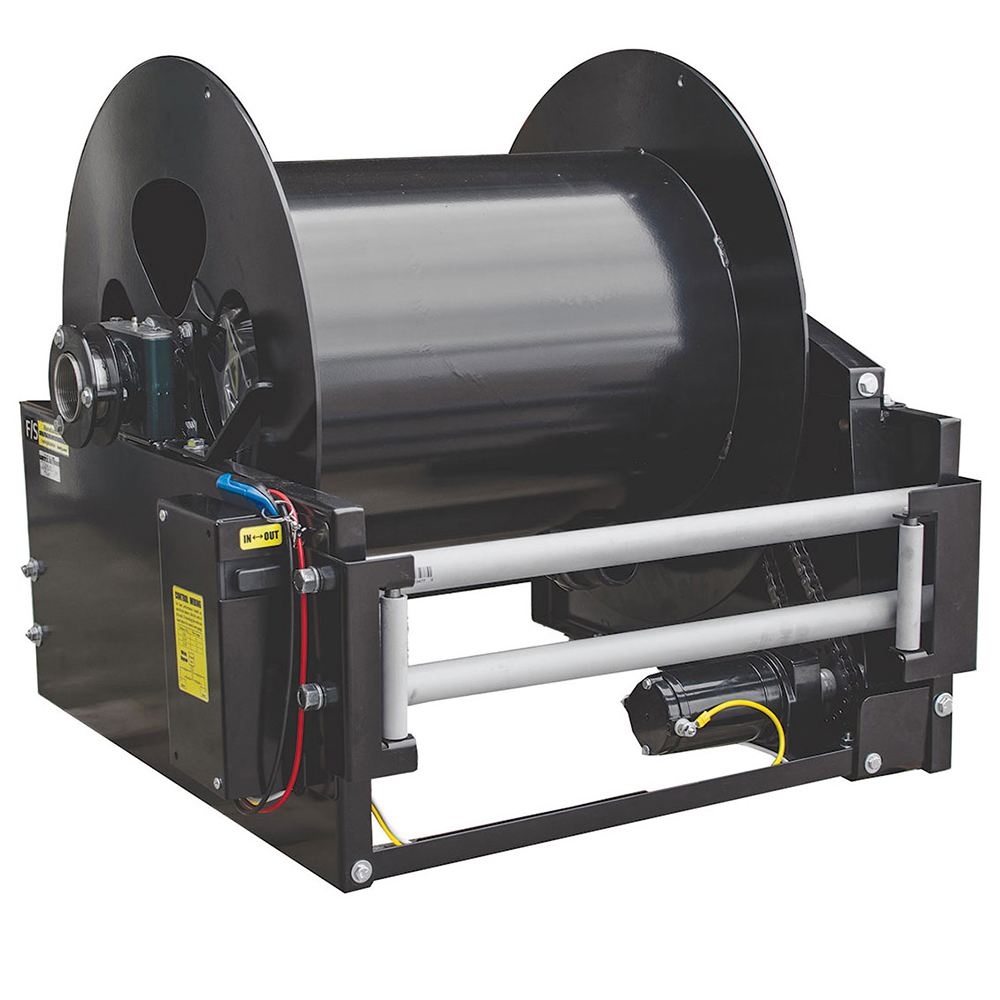
FS Super Reel


Chemical Mixing Systems

The purpose of your tender trailer is to mix your chemicals and water for your sprayer batches. There are several different systems designed to make measuring chemicals, more efficient, accurate, and safer.

Cone Bottom Inductor Tanks

These systems range in features and complexity. The simplest option is to use a cone bottom inductor tank to add your chemicals. Using a 12V pump with a hose-end meter to transfer each product from the chemical shuttle measure them into your tank. The contents of the inductor tank get pulled into your carrier line either from the pump suction or the suction created from a venturi. If you are not familiar with inductor tanks with a venturi, then be sure to read our complete chemical inductor guide

Cone bottom inductor tanks are commonly 15-110 gallons and have a lot of different options. A Chem-Blade rinse system is a stainless blade that fits inside the inductor tank. It allows you to quickly slice jugs open and rinse them out completely. This is a much faster way to add jugs of chemicals and helps avoid spills while pouring. 


DU1A30 Inductor Tank

Easy Caddy Pump/Meter Combo


Dultmeier Quick Chem-Mix System

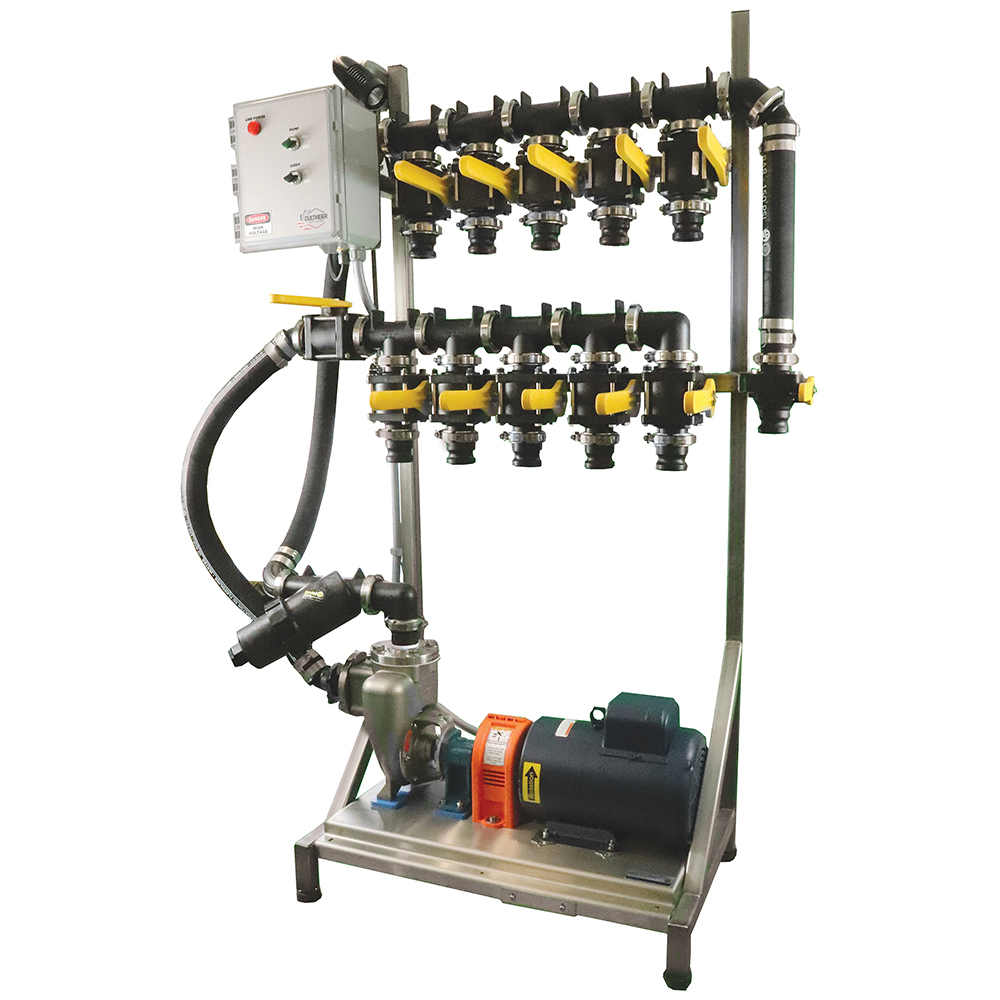
If you want to avoid 12 pumps, this can be done with the Dultmeier Quick Chem-Mix system. This system allows you to make up to six different chemicals with just a single meter and no 12V pumps. Just a single transfer pump. 

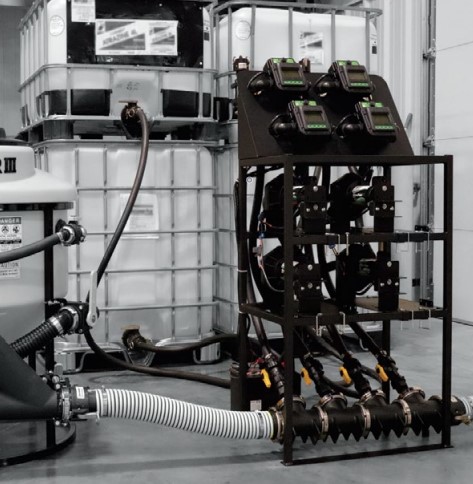
This works similarly to a cone bottom inductor tank, the suction from your transfer pump or venturi assembly pulls chemicals from each mini-bulk tank. Instead of a cone bottom tank on top of the inductor/venturi assembly, you have a manifold with several one-inch valves. 

You manually open a ball valve and meter one chemical at a time through an oval gear meter. This meter does not require calibration for each separate chemical. You can find more detailed information in this guide on setting up the Quick Chem-Mix system. 
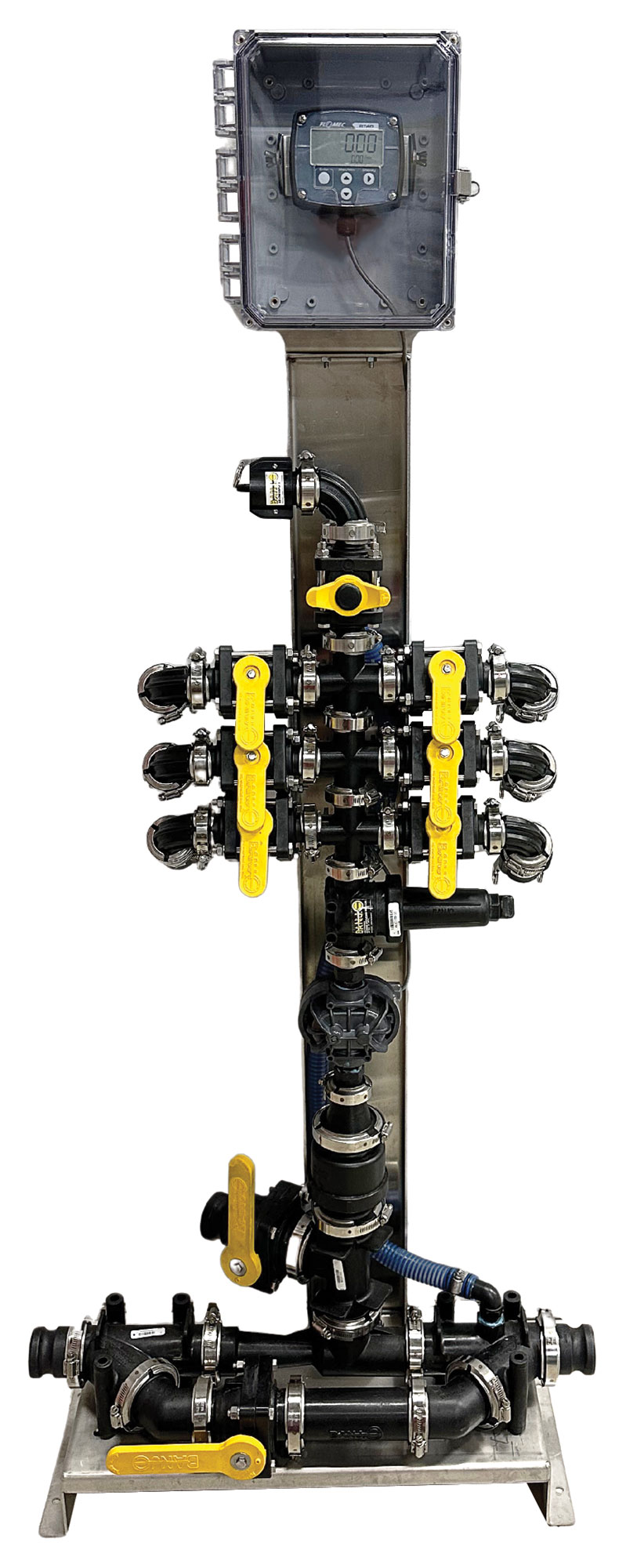
 

Quick Chem-MIx


Dura Auto-Batch Direct Injection System

If you want a system that offers more automation, the Dura Auto Batch Direct Injection system is designed to automatically inject herbicides directly into the sprayer carrier during the tank filling process. It utilizes the Dura Auto-Batch meters to control the pumps. You simply set your desired amount of chemical on the meter and when the amount is reached the pump is shut off. 


You can all of your chemicals at one time, speeding up your process considerably. Dura’s research shows that you can reduce your sprayer fill time by 68 percent! You can take a look at the full system here


Dura Auto-Batch Direct Inject


Key Takeaways

  • Not just volume: Tank shape and features are important to consider as well
  • Plumbing affects flow rate not just your pump size
  • Consistent, full port plumbing to maximize flow
  • Wet seal pumps protect against "run" dry scenario
  • Hose reels keep your trailer organized and safer
  • There are many chemical mixing options no matter your budget

Selecting the right components for your sprayer tender trailer is all about understanding your operational needs and building a system that delivers efficiency and reliability. By focusing on the right pump, tanks, hose reels, and additional components, you can create a trailer that keeps you spraying longer with less downtime.

Need help with your setup? Reach out for expert advice on choosing the perfect components for your tender trailer!



Shane Blomendahl, Author

Tech Ag & Industrial Sales

Shane Blomendahl is a tech sales veteran at Dultmeier Sales with over 10+ years of experience in liquid handling products covering several industries and applications.

Learn More About the Author

Winter Road Safety: Key Deicing Terms Explained
(0) Winter Road Safety: Key Deicing Terms Explained

Deicing is a critical component of winter road maintenance, ensuring that roads, highways, and walkways remain safe and navigable during snowy and icy conditions. However, the effectiveness of deicing practices hinges on a solid understanding of key industry terminology. 

Whether you're a contractor, part of a municipal team, or work with a Department of Transportation (DOT), familiarizing yourself with these terms is essential for successful operations. In this guide, we'll break down the most important deicing terms, helping you to better understand and implement the best practices for keeping roads clear and safe throughout the winter season.

Common Deicing Terms and What They Mean

At Dultmeier, we have decades of experience building and selling deicing equipment. Over the years we have gained a thorough understanding of the industry lingo. So, let’s look at the common terms that you should know.

Anti-Icing

Also known as “pre-treating”, anti-icing refers to the process of spraying liquid deicers on roadways before snow or ice begins to accumulate. This method is primarily used to prevent the formation of ice and to stop snow from bonding with the road surface. 

Anti-icing is also commonly applied on city streets, highways, parking lots, and bridges during the winter to prevent black ice from forming. It can be used on just about any surface that gets vehicle or foot traffic. The typical application rates for anti-icing are in the range of 30-50 gallons per lane mile (*to be certain you should consult your product supplier). This method is proactive, aiming to make it easier to keep roads clear during winter weather.

How It Works:
Anti-icing involves the application of liquid chemicals (e.g., salt brine, magnesium chloride, calcium chloride, & other products) directly to the road surface. These chemicals lower the freezing point of water, preventing ice from forming.

Benefits:

  • Preventative Measure: By applying anti-icing agents before a storm, the road surface is less likely to become icy, which can improve traction and reduce the number of accidents.
  • Efficiency: Applying liquids prior to storms allows you to plan and allocate resources. Brine can be made ready ahead of time and roads get treated when conditions are more friendly. 
  • Reduced Chemical Usage: Anti-icing requires less chemical application compared to de-icing, making it more cost-effective and environmentally friendly.
  • Easier Snow Removal: Since snow is less likely to bond with the pavement, it is easier to plow and remove.

Liquid De-Icing

Liquid de-icing involves spraying liquid deicers on roads after snow or ice has already begun to fall. The purpose of liquid de-icing is to melt the existing snow and ice on the roadway. Because it deals with already-formed ice, de-icing requires higher application rates, approximately 3-5 times greater than those used in anti-icing. This reactive approach is necessary once snow and ice have bonded to the road surface.

How It Works:
De-icing involves spraying liquid (e.g., salt brine, magnesium chloride, calcium chloride, & other products) onto the ice and snow-covered road. These chemicals melt the ice by lowering its freezing point, turning it into slush that can be plowed away.

Benefits:

  • Immediate Action: De-icing can quickly address hazardous road conditions after a storm, making roads safer for travel.
  • Wide Application: It can be applied to various surfaces and conditions where ice has already formed.

The equipment used for liquid de-icing and anti-icing is essentially the same. The primary difference is in the amount of liquid applied and the size of the nozzles used to apply it. We will discuss this more in a minute.

>View Deice and Anti-Ice Sprayers

Self Loading Skid Sprayer for applying Liquid Deicing Chemicals

Pre-Wetting

"Pre-Wetting" refers to the process of spraying liquid deicer onto road salt, either when it is in a salt pile or when it is running up a conveyor or spraying the salt/sand mixture on a truck just as it comes off the spinner or auger. This technique helps enhance the effectiveness of solid deicers by ensuring better adherence to the road surface and improving the melting action.

Benefit: Pre-wetting can reduce the amount of solid material needed, decrease the bounce and scatter of salt, and improve the speed at which ice is melted.

Application Rate

Application rates refer to the quantity of liquid deicer applied per lane mile (GPLM). For example, a common rate for anti-icing with brine might be 30-50 GPLM. This rate can vary depending on factors like weather conditions, type of deicer, and road surface conditions. Controlling the application rate is an important aspect of a de-ice or anti-ice sprayer. The speed at which you travel while applying the liquid affects the overall application rate; if you speed up the sprayer output must increase to maintain your overall GPLM rate. 

There are multiple ways to adjust your rate, manual pressure-based control and automatic rate control. Manual controls require the operator to adjust the pump output as needed when they change speed. This requires that you monitor the flow or pressure and calculate ahead of time the level of adjustment needed for specific increases or decreases in speed. Automatic rate control systems let you set your rate and the system makes the adjustments automatically as speed changes. This is a complex subject and for more details, look at this article that covers sprayer rate control methods, and more detail.

View options for automatic rate controllers here.

Anti-Icing & Deicing Spray Nozzles  

The nozzles used on the sprayer must be sized to accommodate the desired application rate and range of speeds during operation. Additionally, if the same sprayer is used for both anti-icing and de-icing, different sets of nozzles might be needed due to the varying application rates. Variable orifice nozzles are also available. 

Commonly solid stream nozzles are used for de-icing and anti-icing. Solid stream nozzles penetrate the surface of the ice/snow better than flat fan nozzles. Allowing the deicing liquid to melt from the bottom up.

Stainless Steel Deicing Nozzles

Lane Mile

This is a measure of distance, where one lane mile equals one mile of roadway in one lane. To apply the deicer, you need to know the total number of lane miles you will treat. For example, if you are treating a highway that is 10 miles long with 2 lanes, you have 20 lane miles (10 miles x 2 lanes). 

Salinity

Salinity refers to the concentration of salt in a brine solution, typically measured in percentage by weight of salt. Salinity is a key factor in determining the effectiveness of a salt brine used for de-icing or anti-icing. For example, a standard salt brine solution might have a maximum salinity of 26.4% by weight, the point at which the brine is 100% saturated. The optimal salinity for salt brine is close to 23.3% by weight with a -6° F freezing point.  

Salimeter

A Salimeter is a tool used to measure the salinity or concentration of salt in a solution, typically in a brine solution used for de-icing or anti-icing. It provides a direct reading of the salt content in percentage by weight or in terms of saturation, allowing operators to ensure that the brine solution has the optimal concentration for preventing ice formation or for melting existing ice.

How it Works:

  • Measurement Scale: Salimeters typically have a scale that measures the percentage of salt in the solution, with a common range being from 0% to 26.4% for sodium chloride brine (26.4% is the 100% saturation point of salt in water at normal temperatures). Salimeters are also available that measure the percentage of saturation on a scale of 0-100%.

View available Salimeters:

Usage in Winter Road Maintenance: By using a salimeter, DOTs and contractors can verify that their brine solutions are correctly mixed to achieve maximum effectiveness in ice prevention or removal. Proper salinity ensures that the brine is neither too diluted (which would reduce its effectiveness) nor too concentrated (which could lead to waste).

Brine Maker

A brine maker is a specialized system designed for the efficient production of salt brine, which is commonly used for anti-icing and de-icing roadways. The system is designed to mix water and salt to create a brine solution with a precise concentration optimal for preventing ice formation and for treating roads before, during, and after snowstorms.

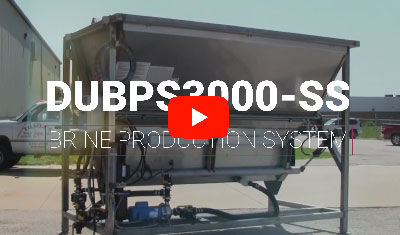
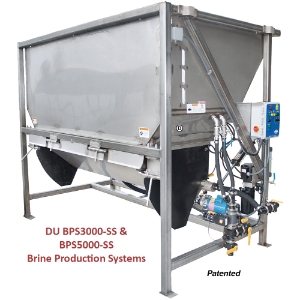
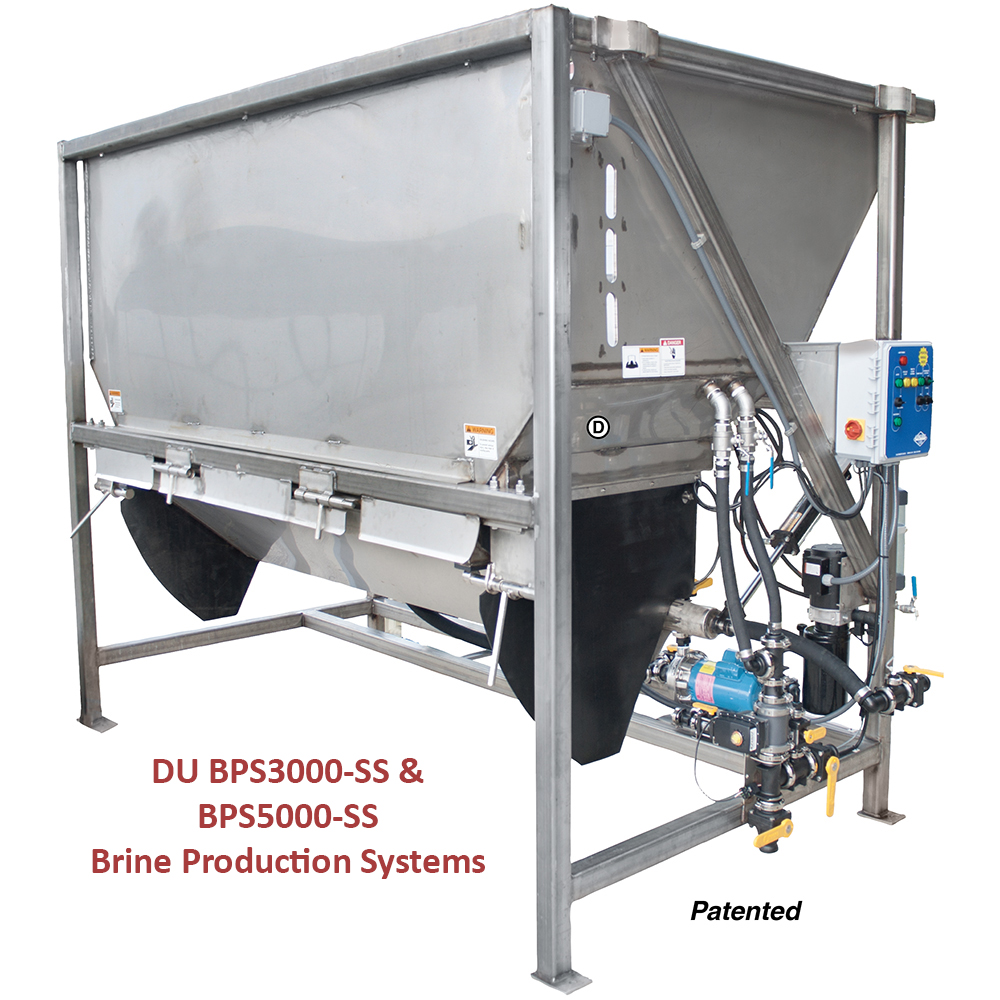
At Dultmeier our brine maker is designed for efficient and reliable production of salt brine, featuring an "easy clean-out" system that simplifies maintenance and reduces downtime. It is built with durable, corrosion-resistant stainless steel, ensuring long-lasting performance in harsh conditions. 

The brine maker also includes simple controls for precise mixing, which guarantees consistent brine concentration. These features make it ideal for municipalities, DOTs, and contractors who need to produce large volumes of brine quickly and maintain their equipment with minimal hassle. This system not only enhances operational efficiency but also helps in cost-effective winter road maintenance.

See more details:

Easy Clean Out Salt Brine Maker

DUBPS3000-SS


Conclusion

Understanding the terminology used in deicing is essential for anyone involved in winter road maintenance. Whether you’re a contractor, part of a municipal team, or work with a DOT, knowing these key terms will help you make informed decisions and apply the best practices for ice and snow control.


Tom Hansen, P.E.

Tom Hansen, Partner and Engineer at Dultmeier Sales, brings over 25 years of expertise in fluid handling equipment for agriculture, deicing, petroleum, and more.

Learn More About the Author

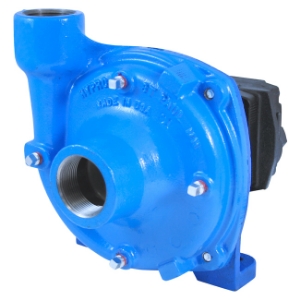
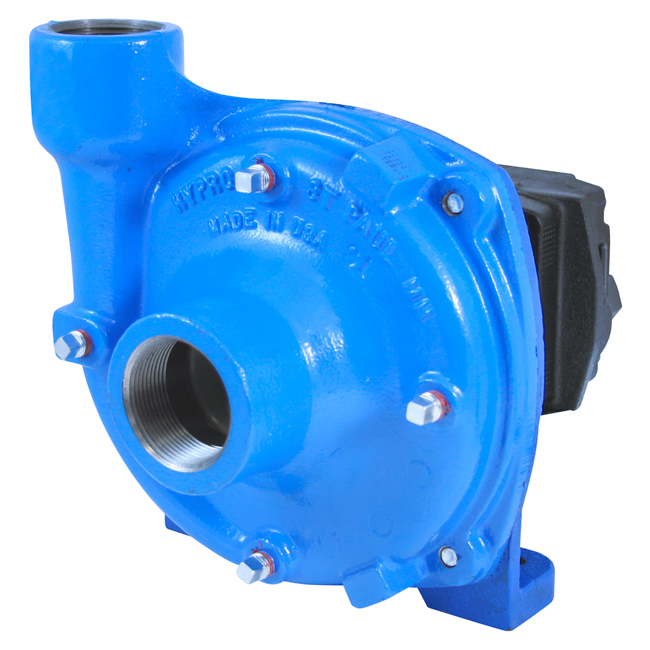
How to Determine Your Hypro Hydraulic Sprayer Pump Model

When your sprayer pump is functioning perfectly, it often goes unnoticed. However, when it starts to leak or fails, identifying the correct repair parts or finding a replacement becomes urgent to minimize downtime. 

This task can be challenging, especially if there are no visible model numbers or identification tags on the pump. Many sprayer manufacturers use Hypro hydraulic motor-driven pumps, but often the nameplate is removed, lost, or becomes unreadable over time. As a result, identifying the original pump can become quite a task.

At Dultmeier, we have been selling the Hypro brand for decades, and experience has taught us what to look for in order to determine your pump model. With the right approach, it is possible to identify your pump’s specifications and find suitable replacement parts or a complete pump replacement.

Guide to Identify Hypro Hydraulic Sprayer Pump

Although examining the physical attributes of your pump is not a 100% accurate way to determine the model of your Hypro pump, it is a good place to start. Often, you can narrow down enough to find repair parts or determine the performance specifications. 

Note: If you are unsure of the pump manufacturer or if you have a different type of pump, you can refer to our sprayer pump guide or give us a call

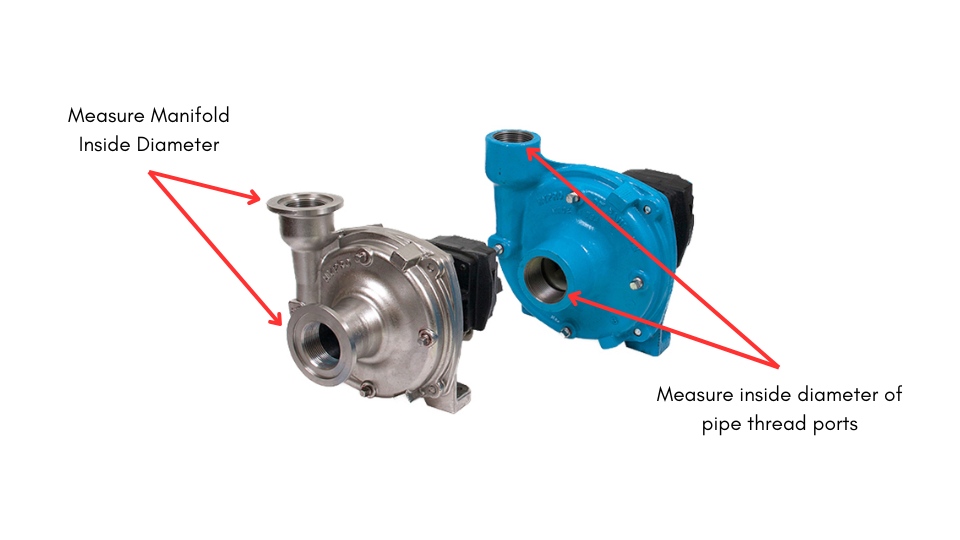
Measure Fluid Port Size/Type

The inlet and outlet ports differ in size and type. Common configurations include threaded connections or manifold flanges. After determining the drive type, measuring the inside diameter of each port will help narrow down your pump model. 

How to Find your Hypro Pump Model Number

Here are the typical port sizes for the different series of Hypro Hydraulic Pumps:

Pump SeriesConnection TypeInlet PortOutlet Port
9303Threaded Connections1-1/2" NPT1-1/4" NPT
 Flanged Connections220 flange (2" ID)200 flange (1-1/2" ID)
9306Threaded Connections2" NPT1-1/2" NPT
 Flanged Connections300 flange (3" ID)220 flange (2" ID)
9307Threaded Connections2" NPT1-1/2" NPT
 Flanged Connections300 flange (3" ID)220 flange (2" ID)
9313Threaded Connections1-1/2" NPT1-1/4" NPT
 Flanged Connections220 flange (2" ID)200 flange (1-1/2" ID)
9314Threaded Connections2" NPT1-1/2" NPT
 Flanged Connections220 flange (2" ID)220 flange (2" ID)
9316

Flanged Connections Only

300 flange (3" ID) 220 flange (2" ID)


Some of these pump series have the same measurements. In this case, you will need to examine some other characteristics to decide which series of pump you have. For example, the 9306, 9307, and 9316 series can all come with a 300 x 220 flange. 

You can determine which series you have by looking at some other characteristics of the pump. You can view more details of each pump below:

  • 9306 - Standard pump with no wet seal
  • 9307 - High flow pump with larger capacity hydraulic motor, significantly larger housing than the 9306
  • 9316 - ForceField wet seal pump. Has a barrier fluid reservoir around the pump seal. 

Hydraulic Motor Variations

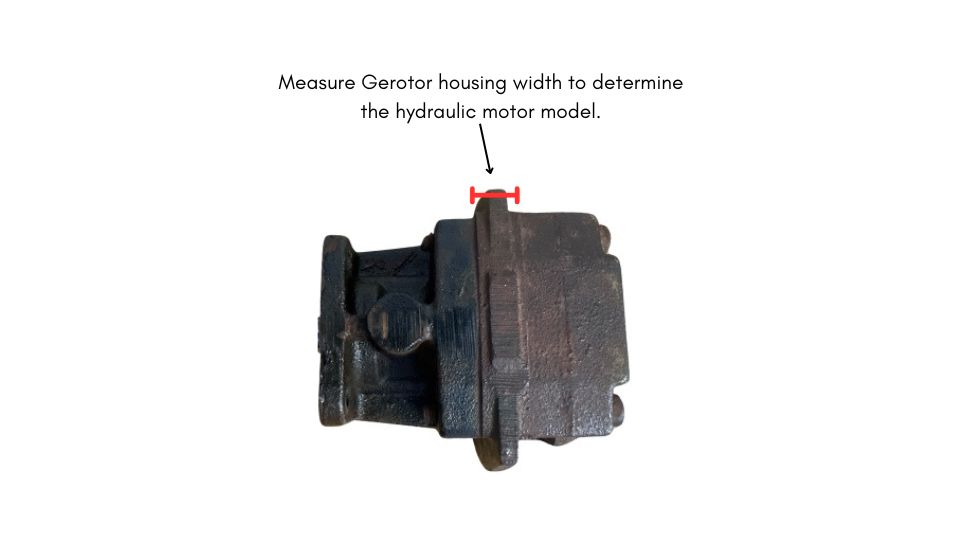
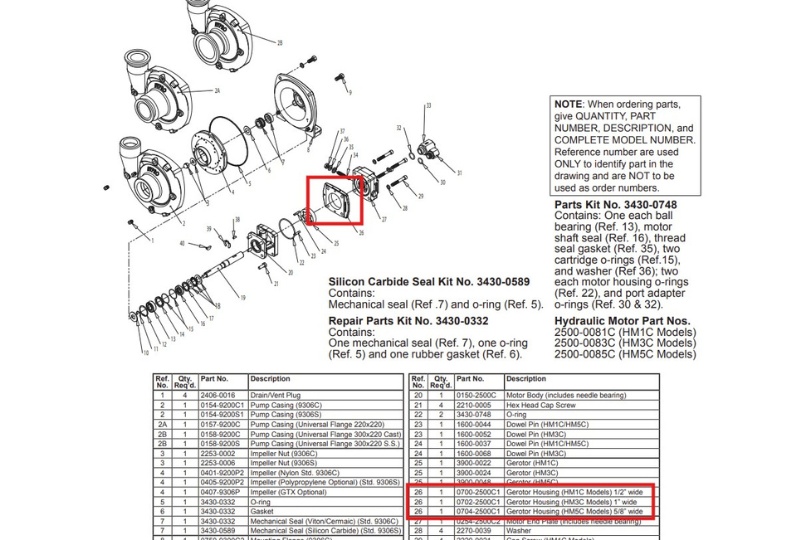
Hypro offers several different hydraulic motor sizes, so measuring the pump ports only tells us part of the info we need. These motors have different hydraulic flow rates and work with different tractors or sprayer hydraulic systems. For the 9303, 9306, 9313, 9314, and 9316 series you can pinpoint the motor type by measuring the motor’s gerotor housing.

In the image below you can see the location of the gerotor and the reference to it in the manual parts breakdown. This shows the gerotor housing width for each different motor model.

Location of Gerotor and Referencing it in the Parts Diagram Table

Hydraulic Motor Sizing Instructions for Hypro Pumps

Do note that you must refer to a Hypro pump manual to find the hydraulic motor measurements for the different motors. 

Housing and Seal Materials

When you have measured the ports and gerotor housing you are most of the way there. The final step is to consider the housing material. The pumps are available in cast iron or stainless steel. This part is easy but it is important to consider. Typically the cast iron pumps are fitted with the standard Viton® /Ceramic mechanical seal and the stainless steel pumps have Life Guard® silicon carbide seals. The Life Guard® seal is intended to last much longer with abrasive liquids. 

Hypro Pump Model Example

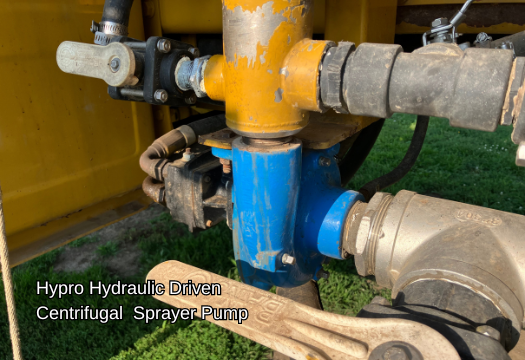
Let’s look at a real example and see if we can determine the model number. In this video, we have a Hypro pump on a self-propelled sprayer. We do not have a nameplate on the pump so we need to measure the ports and hydraulic gerotor housing.

Example of a Hypro Hydraulic Drive Centrifugal Sprayer Pump in Use

The pump has a 2-inch FPT inlet and a 1-½-inch FPT outlet. This means it is a 9306 series pump. The hydraulic motor gerotor housing measures ⅝ inches wide which tells us that we have an HM5 hydraulic motor. Finally, the pump housing is cast iron so all of this info would give us a model of 9306C-HM5

With this info, you can determine the model you have and then find the repair parts or replacement pump you need. If you have questions or would like help give us a call or email today. 


Shane Blomendahl, Author

Tech Ag & Industrial Sales

Shane Blomendahl is a tech sales veteran at Dultmeier Sales with over 10+ years of experience in liquid handling products covering several industries and applications.

Learn More About the Author

Deicing Liquids: What Pump Type Do I Need?
(0) Deicing Liquids: What Pump Type Do I Need?

If you spray deicing fluids on roads or sidewalks, you need your equipment to work whenever winter weather is going to arrive. Your pump is one of the most crucial components of a deicing and snow removal operation. Taking the time to find a reliable option will save you time and money in the long run. 
 

deicing liquid transfer pump system


Dultmeier Sales has been providing pumps and equipment for all types of anti-ice and deicing fluids. Today we will examine the optimal pump units for various de-ice scenarios. 


Types of Pumps for Use With Deicing Liquids 

Many different types of pumps can work with deicing liquids, but centrifugal pumps are the best option for the high-volume transfer requirements of large-scale ice prevention on roads and parking lots. 

The specific centrifugal pumps used should be able to handle the corrosiveness and heaviness of deicing fluids.  A few common deicing liquids include salt brine (NaCl), magnesium chloride (MgCl), and Calcium Chloride (CaCl).  There are others, such as Potassium Acetate, and products that include natural byproducts such as sugar beet and corn-based additives. 

Most of these deicing liquid products are quite corrosive, so pumps constructed of polyethylene, polypropylene, and stainless steel are much better choices than those constructed of cast iron, ductile iron, or aluminum. You can learn more about the materials compatible with salt brine and other device liquids in this de-ice equipment guide that covers the types of tanks, hoses, strainers, etc. that you need.

Standard single mechanical seals with Viton or EPDM elastomers are typically suitable for most deicing liquids, although double mechanical seals are even better with all products and are best for the deicing liquids that have solids in them, such as the sugar beet or corn-based additives.


Transfer Pump Units with Electric Motors

For deicing liquids, centrifugal transfer pumps should be constructed of polyethylene, polypropylene, or stainless steel and should include electric motors that are Totally Enclosed and Fan-Cooled (TEFC).  These are generally in the 2” or 3” size, and most are self-priming.

Here you can see the polyethylene pump units with TEFC electric motors that we stock:  Dultmeier Sales 2 - 10 HP Polyester Centrifugal Pump / Motor Units, Self-Priming - Dultmeier Sales

For deicing Liquids, it is important to select models with a Specific Gravity (S.G.) Rating of at least 1.2 or higher; this means the pump unit can safely pump liquids that are heavier than water (which has a 1.0 S.G. Rating).  This will typically be 3HP, 5HP for 2” sizes, and 7.5HP or 10HP for 3” sizes.  This will prevent the electric motor from overloading and tripping circuit breakers when pumping at high flow rates.

Recommended High-Volume Deice Liquid Transfer Pumps:

Poly Transfer Pump with Orange Peel Guard and Electric Motor

Stainless Transfer Pump with Orange Peel Guard and Electric Motor


Transfer Pump Units with Gas Engine Drives  

These centrifugal transfer pumps are popular where sufficient electrical power is not available.  Be sure to select 5HP engine models in the 2” sizes and at least 6.5HP for 3” size pumps.  Here are some popular 2” Polypropylene Transfer Pumps with 5HP Honda Gas Engines that we stock: 

Close Coupled Poly Transfer Pump with Honda Engine

Sprayer Pumps with Hydraulic Motors

Centrifugal Transfer Pumps are designed to move relatively high volumes of liquid (100 to 300 GPM for 2” and 3” sizes) but not for high-pressure spraying. So for Anti-ice and De-ice Sprayers, it is important to use centrifugal pumps that are designed for spraying.  These pumps can generate much higher pressures than centrifugal transfer pumps.  Most of these centrifugal sprayer pumps have integral hydraulic motors and run off the hydraulic hoses that run into and out of the hydraulic motor on the pump. 

Many models can develop pressures of 80 to 100 PSI, so they can force liquid through the spray nozzles at sufficient volume to properly anti-ice and de-ice the roadways.  It is very important to size your sprayer pump properly for the application rate (in gallons per lane-mile) and average speed your truck will be driving.  We can assist you with sizing these sprayer pumps. 

It is also important to select a sprayer pump with the correct hydraulic motor to match your hydraulic system's oil flow rate (gallons per minute of hydraulic oil).  Note that these pumps can be constructed of cast iron and will last reasonably long with deicing liquids if flushed out periodically (and definitely after each spray season and then filled with RV Anti-Freeze or other non-corrosive liquids).

Here are some centrifugal sprayer pumps (cast iron and stainless shown) with hydraulic motors from Hypro that are popular for spraying deicing liquids at proper application rates and speeds: 

Hydraulic Sprayer Pumps


Maintenance:  Always remember to flush out all deicing liquids from your pump units right after the season ends and fill them with RV Anti-Freeze or other non-corrosive liquid.  This will help your pumps last many years.

Tech Sales and Engineers on Staff to Assist You:  We can help you size and select the correct transfer pumps and sprayer pumps for your liquid deicing applications.  Just give us a call.


Tom Hansen, P.E.

Tom Hansen, Partner and Engineer at Dultmeier Sales, brings over 25 years of expertise in fluid handling equipment for agriculture, deicing, petroleum, and more.

Learn More About the Author